

Salesforce Consulting Blog

Shadow CRM is killing your Salesforce ROI. How to spot it and shut it down.
Your team has Salesforce. They also have a Google Sheet called "Real Pipeline." A Notion page with the actual account list. A WhatsApp group where the deals get discussed. A Trello board that the BDRs trust more than the Lead object. Three reps who track their commissions in their own personal Excel files because they do not believe the dashboards.

Duplicate records in Salesforce: Why they keep coming back and how to stop them
You cleaned the duplicates last quarter. You ran the merge tool, ran a report, and celebrated a cleaner account list. Ninety days later, the reps are complaining again. The same account appears three times. The same lead is assigned to two people. The same contact lives in four records with slightly different spellings.

The Salesforce HIPAA Audit Checklist your team is probably missing
A field-tested checklist for auditing HIPAA compliance inside Salesforce. Covers permissions, encryption, integrations, AI tools, and the mistakes that lead to seven-figure penalties.

Free AI agent training in NYC by Salesforce on April 29. What your org needs before you walk in.
Salesforce is hosting Agentforce World Tour at the Javits Center in New York City on April 29, 2026. Full day. Free to attend. Over 130 sessions, hands-on labs where you build real AI agents, and live demos of Agentforce 360 and Data Cloud.
Salesforce Admin Salary Guide 2026: Key Trends and Analysis
The 2026 Salesforce Salary Survey is out, and the numbers tell an interesting story. Salesforce Admin salaries are flattening. The job market is tougher. And the expectations placed on admins are expanding well beyond traditional admin work.
For businesses trying to get real value from Salesforce, this raises a question worth asking: is hiring a full-time admin still the best way to support your org?

Is your Salesforce org ready for Agentforce? 7 things to check first.
Agentforce is live. Salesforce has been pushing it hard since Dreamforce, and if your org is on Enterprise Edition or above, there's a good chance someone on your leadership team has already asked: "When are we turning this on?"

Salesforce HIPAA Compliance Pitfalls to Avoid in 2026
In 2026, the compliance bar is moving. The proposed HIPAA Security Rule update, expected to be finalized by mid-2026, will eliminate the distinction between "required" and "addressable" safeguards. Encryption, MFA, annual penetration testing, and documented risk management will all be mandatory. For healthcare companies running Salesforce, a generic setup is no longer good enough.

Why is your Salesforce so slow? The answer is usually these 4 things.
Page load drag, duplicate records, and governor limit errors don't just frustrate your reps. They cost you deals.
If your Salesforce users are complaining about slow load times, you've probably heard the same workaround:
This blog breaks down what's actually dragging your CRM down
Why your Salesforce Pipeline Reports keep missing the real number
Every quarter, it plays out the same way. The pipeline report says $4.2M. The VP of Sales says it's closer to $3M. Finance has already modeled off a completely different number. The forecast call turns into 30 minutes of people arguing about which version of the data to trust, and nobody actually talks about what to do next.

5 Signs your Salesforce Implementation is working against you
According to industry research, more than 70% of CRM implementations fail to deliver their intended value, not because Salesforce is the wrong tool, but because the implementation was not set up to match how the business actually works.
The good news is that most of these problems are fixable. But first, you have to recognize them

Salesforce data cleanup vs. data redesign: What actually works?
As organizations grow, so does the complexity of their Salesforce environment. New teams come onboard. New products launch. New processes evolve. Over time, what once felt streamlined can begin to feel fragmented.
When reporting becomes inconsistent or users lose confidence in dashboards, the first instinct is often the same: We need a data cleanup.

How to choose the right Salesforce Consulting Partner
Salesforce has become a critical system for how businesses manage relationships, data, and decisions. Yet simply having Salesforce in place does not guarantee value. For many business leaders, the real challenge begins after implementation: adoption slows, reporting becomes unreliable, and the system no longer reflects how the business actually operates. In these moments, choosing the right Salesforce consulting partner becomes a defining decision.

Nonprofit Dreamin’ 2026 Conference for Nonprofit Salesforce Teams in Charlotte, NC
Nonprofit Dreamin’ 2026 brings together nonprofit leaders, Salesforce administrators, consultants, and partners who work hands-on inside Salesforce every day.
This is a working conference for people responsible for keeping Salesforce running, improving it, and making sure it supports real nonprofit outcomes.
The event takes place March 25 to 27, 2026, in Charlotte at the Foundation for the Carolinas
Why Salesforce Integrations break and how to fix them
Salesforce is often blamed for slow reporting, broken automations, and unreliable forecasts. In reality, the issue usually lives between systems, not inside them.
After working inside complex Salesforce environments across finance, nonprofit, and enterprise teams, we see the same pattern repeat. When integrations are not designed intentionally, Salesforce inherits the risk. What looks like a CRM problem is usually an architectural one.

The Definitive Guide to Salesforce HIPAA Compliance for Healthcare Companies in 2026
In 2026, HIPAA compliance is no longer a legal checkbox for healthcare companies using Salesforce. It is a measurable financial risk, an operational responsibility, and increasingly, a leadership accountability.
Healthcare organizations are centralizing more patient data, workflows, and analytics inside Salesforce than ever before.

How to tell if your Salesforce architecture is healthy
Salesforce rarely breaks in ways that trigger alarms. It keeps running. Users keep logging in. Reports still load. Automations still fire. And yet, the system slowly becomes harder to change. That is architecture health declining.
The real question is whether the way it is built still matches how the business actually operates.

Is Salesforce too complex for non-technical Teams?
When non-technical teams struggle with Salesforce, the platform is often blamed first. In practice, Salesforce itself is rarely the issue. Almost every case of “Salesforce is too complex” can be traced back to how the system was designed, structured, and governed after go-live.
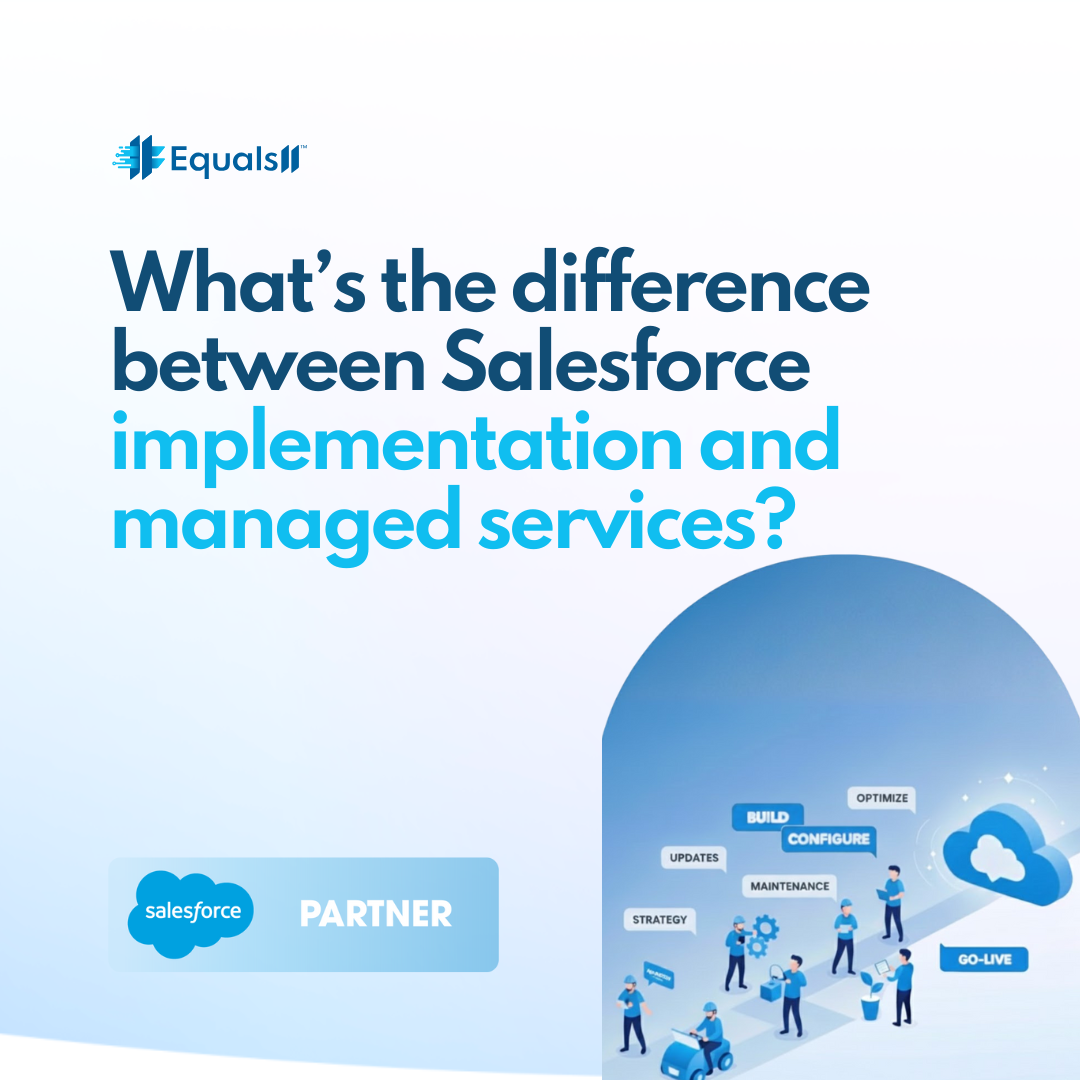
What’s the difference between Salesforce implementation and managed services?
Most Salesforce programs do not struggle during implementation. They struggle after go-live.
At launch, the system works. Core workflows are live, reports exist, and users are trained well enough to operate day to day. On paper, the project is a success.
The problems start quietly months later, when the business begins to change but the Salesforce org does not evolve with it.

Q1 2026 Salesforce optimization checklist
Specific Salesforce actions, backed by Salesforce sources.
Salesforce guidance is clear that platform value comes from intentional configuration, trusted data, and continuous iteration, not from adding features year after year. Q1 is the ideal time to reset the foundation.
Below is a Salesforce-specific checklist to start 2026 correctly.
How to make sure AI inside Salesforce is safe, compliant, and aligned with our business rules?
For all the hype around AI transformation, very few organizations focus on the factor that determines whether AI succeeds: governance. Inside Salesforce, this is critical because data, workflows, compliance, and customer interactions all operate within one connected ecosystem.
When governance is weak, AI becomes unpredictable, hard to trust, and often too risky to scale. Most failures happen not because the technology lacks capability but because the organization was not prepared.