
How to tell if your Salesforce architecture is healthy
Salesforce rarely breaks in ways that trigger alarms. It keeps running. Users keep logging in. Reports still load. Automations still fire. And yet, the system slowly becomes harder to change. That is architecture health declining.
The real question is whether the way it is built still matches how the business actually operates.
What Salesforce architecture health actually means
Architecture health has nothing to do with how modern your org looks or how many features are enabled.
A healthy Salesforce org is one where change behaves predictably.
When a requirement comes in, teams can explain where it belongs, what it will affect, and what risk it introduces before anything is built. Releases do not rely on heroics. Knowledge is not trapped in one admin’s head. The system absorbs growth instead of amplifying complexity.
When architecture health declines, Salesforce still works. It just stops being trustworthy as a decision platform. That is the point where the org becomes fragile.
Why architecture problems are almost always missed
Salesforce is designed to be forgiving.
You can add automation without removing old logic. You can solve edge cases with exceptions instead of redesign. You can integrate systems without clearly defining ownership. You can grant access to fix an issue and never revisit it.
Early on, this flexibility is what makes Salesforce valuable.
Later, it hides architectural debt.
Instead of visible failure, teams experience hesitation. Admins avoid touching certain flows. Enhancements take longer than expected, but no one can point to a single cause. Reporting debates replace reporting decisions. Releases feel risky even when the change is small.
The pattern behind “adoption issues” that are not adoption issues
When users struggle, most teams assume the answer is training.
In mature orgs, poor adoption is often a symptom of architectural drift.
When the data model no longer reflects how the business actually works, users are forced to work around it. When automation grows without clear responsibility boundaries, outcomes become inconsistent. When security evolves through exceptions, users see different results for the same action and stop trusting the system.
At that point, no amount of enablement fixes the root problem. The system is asking users to compensate for architectural decisions made years earlier under very different constraints.
How to read the health of your Salesforce org
Architecture health always reveals itself in the same places.
The data model shows whether Salesforce represents the business as it exists today or as it existed when the org was first designed. In healthy orgs, ownership is clear, and reporting behaves consistently. In unhealthy ones, duplicate concepts exist because refactoring felt too risky at the time.
Automation shows whether speed was balanced with structure. When execution order is intentional and observable, teams can change behavior with confidence. When logic is layered without a governing pattern, small updates create unpredictable outcomes.
Security shows whether access was designed or accumulated. Healthy orgs can explain why users have access. Unhealthy orgs only know that they do.
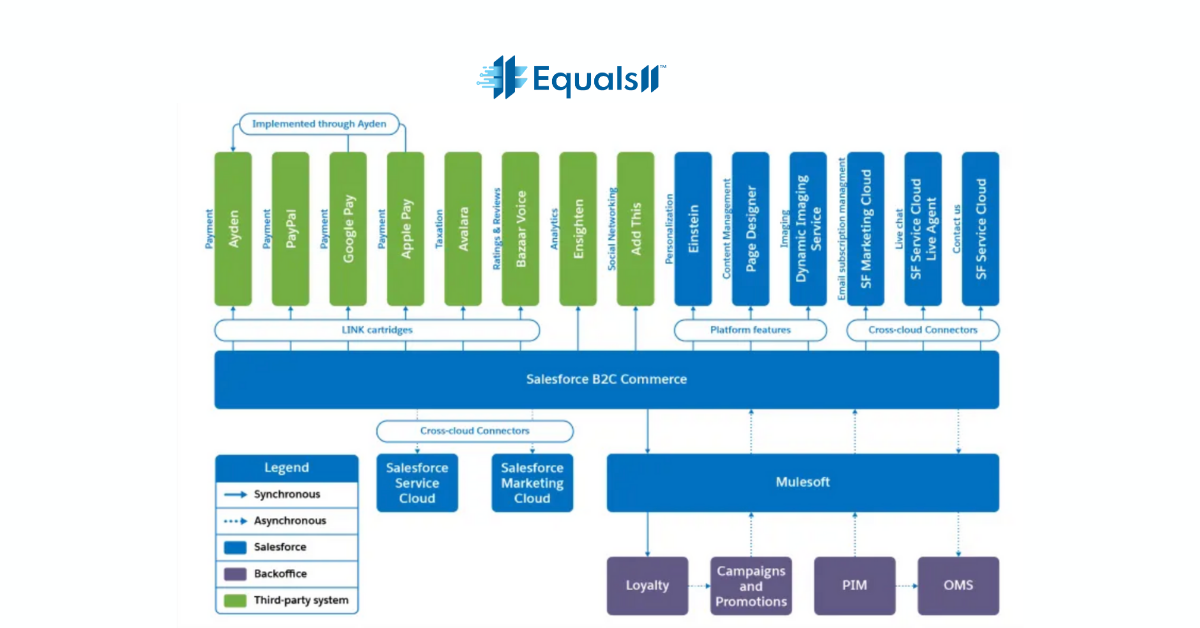
Integrations expose architectural maturity quickly. When systems of record are clearly defined, integrations evolve safely. When they are not, data correctness becomes fragile, and errors surface late or not at all.
Governance determines whether the org is being steered or merely reacting. Healthy governance does not slow delivery. It prevents rework. Unhealthy governance appears as rushed decisions that create long-term constraints.
Finally, platform limits and performance reveal whether growth was planned for or merely survived. Teams with architectural headroom do not worry about scale. Teams without it discover limits under pressure. None of these fails loudly. They fail gradually.
What your architecture health is telling you
Most orgs land in one of three states.
Some are healthy. Change feels routine. Salesforce supports the business without drawing attention to itself. Leadership can plan confidently because the system behaves as expected.
Many are fragile. Everything works until it does not. Progress depends on a few individuals. Large initiatives feel riskier than they should. Teams sense the tension but cannot quite name it.
Some are critical. Salesforce has become a constraint. Teams avoid improvements unless forced. Strategy bends to fit system limitations instead of the other way around.
The difference between these states is rarely budget or effort. It is whether architecture was treated as a living responsibility.
The real cost of ignoring architecture health
Architecture debt does not show up as a failed deployment.
It shows up as slower decisions, longer delivery cycles, and rising delivery costs for the same level of change. It increases dependency on specific people. It forces rebuilds at the worst possible time, during growth, mergers, or system replacements.
Over time, leadership starts questioning Salesforce itself, when the real issue is how it was allowed to evolve. That is when organizations pay twice. Once for the original shortcuts, and again to undo them.
What scalable Salesforce orgs do differently
Scalable orgs do not avoid complexity. They manage it deliberately.
They make architectural decisions explicit instead of implicit. They treat governance as a delivery accelerator, not a bottleneck. They separate urgency from importance and understand when a quick fix is actually expensive.
Most importantly, they reassess whether Salesforce still reflects how the business operates today, not how it used to. No new tools required.
The only decision that matters next
Once you see the health of your architecture, there are only three rational paths.
You can stabilize by reinforcing weak areas without redesigning the system. You can refactor by realigning Salesforce to your current business reality. Or you can contain the debt by accepting the cost while planning for a future transition.
Avoiding the decision does not preserve flexibility. It removes it.
Proof from the field
This level of architectural clarity is what enterprise teams expect in practice:
Excellent partner experience - highly recommended
“Equals 11 delivered an exceptional level of expertise and partnership throughout our Salesforce initiative. Their team provided top-tier resources who consistently outperformed expectations across Salesforce Sales Cloud, Service Cloud, and ServiceMax.
One of the most impressive aspects of the engagement was their leadership in executing a full org conversion to a new production instance, an effort that was both complex and mission-critical.
They also played a key role in integrating our new Salesforce environment with a new SAP S/4 system, ensuring a smooth, well-architected, and future-ready solution.
Throughout the project, Equals 11 demonstrated deep technical knowledge, strong communication, and a true commitment to our success.
I would confidently recommend Equals 11 to any organization seeking a highly capable and reliable Salesforce consulting partner.” - Salesforce Verified Review, United States (Jan 10, 2026)
At Equals 11, we help leaders surface architectural reality early, while options are still inexpensive.
Sometimes the fastest way to get clarity is simply to talk it through with someone who has seen this pattern before.
If that would be useful, a brief call with the Equals 11 team can help you pressure-test assumptions before committing to any major changes. Book a 20-min call.
For smaller or growing teams, a short call early can prevent months of cleanup later.
This is typically where Pisco steps in, either by validating a Salesforce setup during a QSI or by maintaining architectural health through ongoing managed services as the org evolves.
