
Why your Salesforce Pipeline Reports keep missing the real number
Every quarter, it plays out the same way. The pipeline report says $4.2M. The VP of Sales says it's closer to $3M. Finance has already modeled off a completely different number. The forecast call turns into 30 minutes of people arguing about which version of the data to trust, and nobody actually talks about what to do next.
The natural reaction is to fix the reports. Build a new dashboard. Add another filter. Hire a Salesforce admin to "clean up the data." And that work might produce a better-looking dashboard, but it won't fix the problem, because the problem was never the report.
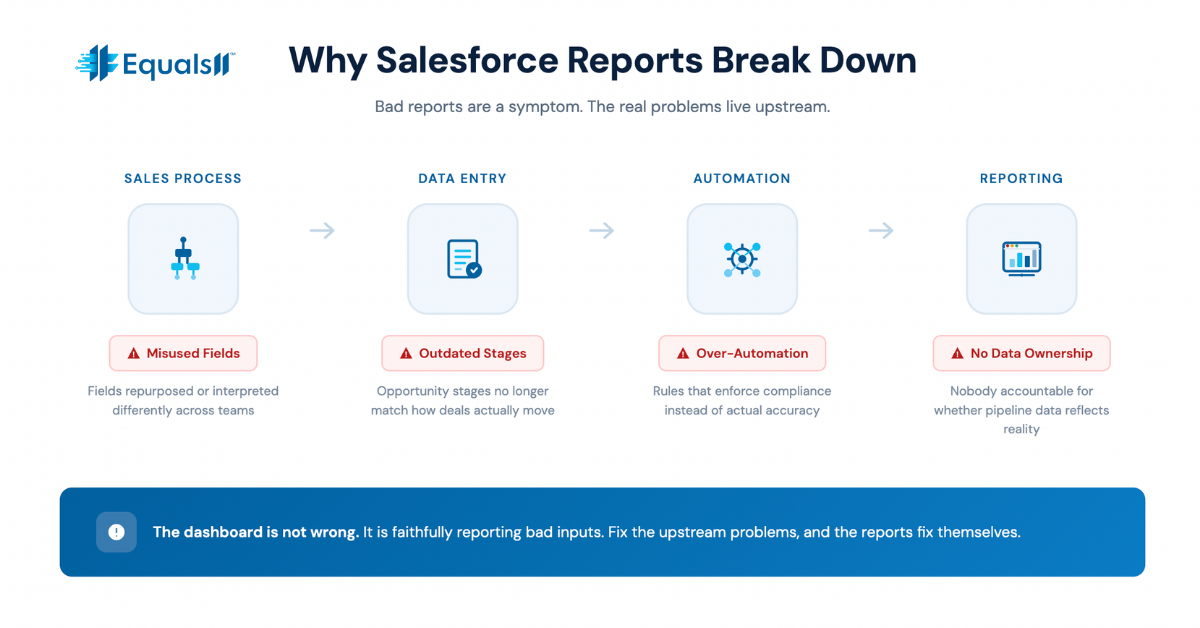
The report is doing its job. The data underneath it isn't.
When Salesforce reports consistently miss reality, the root cause is almost always structural. It lives in how objects were configured, how fields are being used (or misused), and how much the actual sales process has drifted from the process Salesforce was designed around.
What that looks like in practice:
Fields that have lost their meaning. "Close Date" was supposed to represent when a deal would actually close. Now it's a placeholder that reps push forward every month because nobody defined what triggers a real close date. "Stage" was supposed to track buying progression, but it's become a negotiation tool. Reps move deals to later stages to signal optimism on pipeline reviews, or keep them early to avoid scrutiny. The field is populated. It's just not accurate.
A sales process that moved on without Salesforce. Most orgs build their Salesforce instance around the sales motion they're running at the time. Two years later, they've added a PLG motion, or the deal cycle has changed, or they've started selling to a different buyer. The system still reflects the old motion. Reps work around it because they have to. They skip stages, repurpose fields, or stop updating records that don't apply anymore. From their perspective, they're being efficient. From a data perspective, the signal-to-noise ratio tanks.
Automation that enforces compliance, not accuracy. Validation rules and flows are usually built to force reps to fill in fields before they can move a deal forward. The intent is data quality. The result is the opposite: reps learn to enter the minimum information that lets them click "Save." A required field that's always filled in with "TBD" or "N/A" is worse than useless. It creates the illusion of complete data while actively degrading report accuracy.
Nobody owns the data. Sales leadership assumes the CRM "handles" accuracy. The ops team assumes sales "owns" the data. The admin assumes the validation rules enforce quality. Nobody has actually been assigned accountability for whether the pipeline number in the Thursday forecast matches what's happening in real conversations with buyers. So the data quietly rots, and the reports faithfully reflect that rot.
What actually needs to change
The fix isn't more reports. It's a tighter alignment between how your team actually sells and how Salesforce is configured.
That means opportunity stages need to represent things you can observe - a discovery call happened, a proposal was delivered, a verbal commitment was given - rather than internal feelings about deal momentum. Required fields should be limited to data the business actually uses to make decisions. If nobody looks at a field to make a decision, it shouldn't be required. Automation should support how reps work, not punish them for working the way the business now demands.
And somebody needs to own the data. Not "the system." Not "the team." A specific person or role is accountable for whether pipeline data reflects reality. Without that, reporting accuracy is everyone's concern, not anyone's responsibility.
When this alignment exists, something changes about how the company operates. Dashboards stop being a source of debate and start being a source of decisions. The Monday pipeline review moves from "are these numbers right?" to "what do we do about these numbers?" That shift is worth more than any dashboard redesign.
This doesn't require starting over
You don't need a full Salesforce rebuild. You don't need a six-month transformation program. What you need is a disciplined review of where the data model, the sales process, and the automation layer have drifted apart, and targeted work to bring them back into alignment.
That's a different kind of work than the initial implementation. It's less about building new things and more about removing friction, simplifying what's already there, and restoring trust in the numbers.
This is exactly the kind of work Equals11 does. As a certified Salesforce consulting partner with 600+ certified Salesforce professionals, Equals11 specializes in post-implementation optimization, identifying where reporting problems are symptoms of deeper design misalignment, then reshaping the system so the data, the process, and leadership visibility line up again. Clients who go through this work tend to describe the outcome the same way: they stopped arguing about the numbers and started trusting them.
If your forecast calls have turned into data accuracy debates, the problem is upstream of the report builder. A focused assessment can show you exactly where structure and process have come apart. Start the conversation here.
