
Why Salesforce Integrations break and how to fix them
Salesforce is often blamed for slow reporting, broken automations, and unreliable forecasts. In reality, the issue usually lives between systems, not inside them.
After working inside complex Salesforce environments across finance, nonprofit, and enterprise teams, we see the same pattern repeat. When integrations are not designed intentionally, Salesforce inherits the risk. What looks like a CRM problem is usually an architectural one.
This is how integration fragility shows up, why it happens, and what mature Salesforce teams do differently.
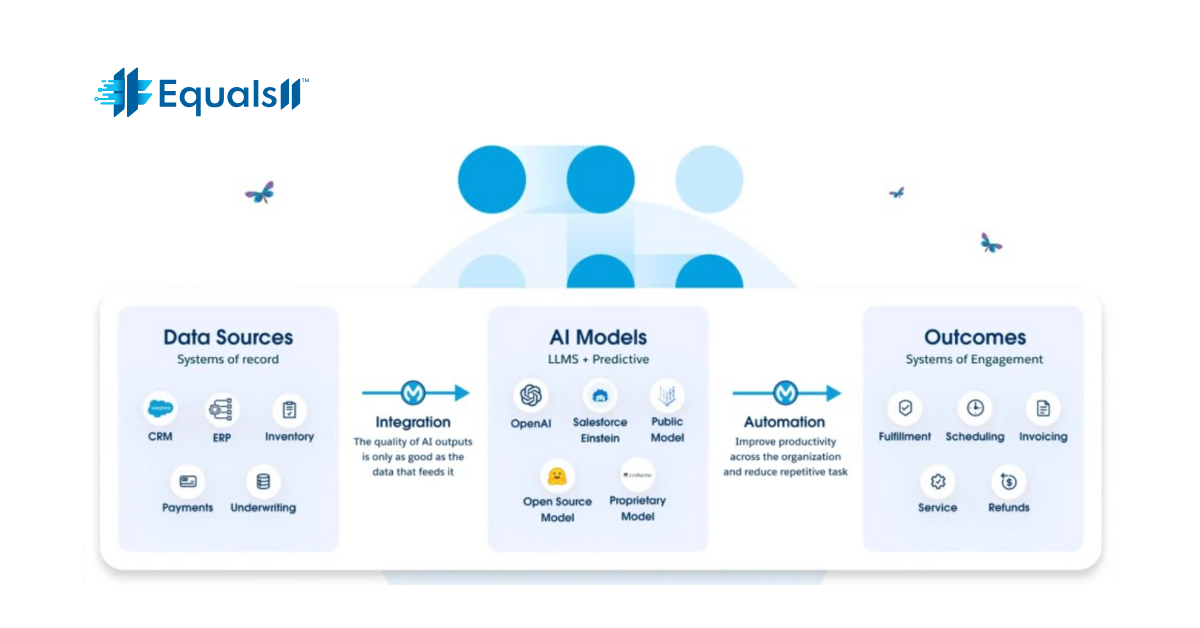
5 integration fixes you can implement right away
1. Enforce a Single System of Record per Data Domain
Most integration failures start when two systems believe they own the same data.
This must be enforced in integration logic, not documentation. If finance owns invoices and revenue, Salesforce should reference that data, not overwrite it. Block updates at the integration level so Salesforce cannot become the accidental source of truth.
If your team cannot clearly state which system wins for customers, orders, products, or revenue, your integrations are already fragile.
2. Stop Syncing Status Fields and Sync State Transitions
Syncing raw status fields creates race conditions when systems update at different times.
Instead, integrate on business events such as Order Approved, Invoice Posted, or Payment Applied, then map those events to specific Salesforce actions. This reduces timing issues, prevents update loops, and makes failures easier to diagnose. Mature Salesforce environments integrate events, not fields.
3. Make Every Write Consistent
If an integration retries a failed record, it should never create duplicates.
Every write into Salesforce should be idempotent, meaning the same payload can be processed multiple times without side effects. This requires consistent use of external IDs and strict controls around record creation. Most teams skip this and only discover the problem during retries or backfills.
4. Separate Operational Data from Reconciliation Data
Not all data needs to be real-time.
Operational data that supports users should follow a fast path. Reporting, audit, and finance data should follow a separate reconciliation path. This reduces system load and prevents reporting fixes from breaking live workflows. Salesforce performs better when it is not forced to be real-time for everything.
5. Treat Integrations Like Production Systems
If an integration fails today, how long until someone notices?
If the answer is when a user complains, that integration is already a risk. Teams need visibility into failures, retries, and affected records. This is where platforms like Celigo matter, because they surface problems early instead of hiding them behind scripts.
What stable Salesforce Environments do differently
High-performing Salesforce teams treat integrations as part of their core architecture. They define data ownership clearly, expect change, and design integrations so failures are visible and contained.
This is what allows Salesforce to remain reliable as transaction volume grows and business rules evolve.
Where Celigo fits
Equals 11 recently became a certified partner of Celigo to support this level of integration discipline.
Celigo is an enterprise-grade integration platform used to connect Salesforce with ERP and finance systems such as NetSuite. Its value is not just connectivity, but observability, error handling, and control. This turns integrations from a hidden risk into a managed capability.
What this looks like in practice
Most clients do not come to Equals 11 asking for better integrations. They come because Salesforce feels harder to trust than it should.
Reports require manual validation. Forecasts lag reality. Automations behave inconsistently. By examining how data actually moves between systems, we help teams stabilize Salesforce as a decision platform.
As one enterprise client shared:
“Equals 11 evaluated our Salesforce-native rail logistics prototype and delivered insights no other partner had provided, including a clear build-versus-buy matrix and a realistic roadmap.”
— Rail Logistics Client, USA
Smaller teams see the same impact:
“This engagement helped us make our Salesforce environment more relevant and useful.”
— Healthcare & Life Sciences Client, USA
Why clients choose Equals 11
Equals 11 is an execution-first, certified Salesforce partner trusted by lean teams and complex enterprises. Clients choose us for our ability to turn abstract problems into decision-ready backlogs, prescribe only what is needed, and deliver consistently on time and under budget.
We are backed by more than 600 certified Salesforce engineers and have been named a Top CRM and Nonprofit Partner three years in a row.
If we could help you reduce reconciliation effort, free your team for higher-value work, and improve the data behind your decisions, would it be worth 20 minutes?
Book a demo, schedule a discovery call, or contact us here:
