
How to choose the right Salesforce Consulting Partner
Salesforce has become a critical system for how businesses manage relationships, data, and decisions. Yet simply having Salesforce in place does not guarantee value. For many business leaders, the real challenge begins after implementation: adoption slows, reporting becomes unreliable, and the system no longer reflects how the business actually operates. In these moments, choosing the right Salesforce consulting partner becomes a defining decision.
A strong Salesforce consulting partner does more than configure features. They help align the platform with business reality, ensure data can be trusted, and design solutions that scale as the organization evolves. The wrong partner, however, can introduce complexity that is difficult and costly to undo.

Start with the business, not the technology
One of the most common mistakes organizations make when evaluating Salesforce partners is starting with solutions instead of constraints. Leaders ask for automation, AI, or new functionality before clarifying where decisions break down, where handoffs fail, or which metrics leadership actually trusts. The result is Salesforce doing more work, but creating less clarity.
Experienced partners start differently. They ask questions like which reports leadership exports to Excel before meetings, where deals stall because fields don’t match reality, and which teams maintain shadow systems outside Salesforce. These answers surface the real problem far faster than feature requests. Salesforce should be designed to remove friction from decisions, not just add capabilities to the system.
The importance of long-term system health
Salesforce’s flexibility is both its strength and its biggest risk. Many organizations accumulate technical debt not because they moved too fast, but because no one enforced design discipline early on. Custom objects multiply, flows stack on top of broken logic, and every new request becomes harder to deliver than the last.
Strong Salesforce partners design with longevity in mind. A common rule experienced consultants follow is that if a junior admin cannot safely maintain or modify something a year later, it is likely over-engineered. These partners are deliberate about when customization is justified and when standard functionality should be preserved, understanding how today’s decisions affect upgrades, integrations, and scalability.
Why data quality matters more than features
Most Salesforce issues attributed to poor reporting are actually data model problems. Fields mean different things to different teams, required fields are bypassed, and validation rules don’t reflect real workflows. Adding new features on top of this foundation only accelerates confusion.
The right partner treats data quality as a design outcome, not a cleanup task. They examine who enters data, when it is entered, and what happens when it is wrong. They enforce ownership of critical fields and resist capturing data that no one actively uses. When data is designed correctly, reporting and automation start working naturally.
Designing Salesforce for real adoption
Low adoption is rarely caused by insufficient training. More often, Salesforce feels unintuitive or disconnected from how work actually gets done. When users need too many clicks to complete high-frequency tasks, they will find workarounds.
Strong partners design Salesforce to mirror real workflows, not idealized process diagrams. They remove unnecessary fields, reduce friction in core actions, and align page layouts to the decisions users make at each stage. A simple heuristic many experienced consultants use is that if users have to scroll extensively to do their job, the design likely needs refinement. Adoption improves when Salesforce feels like an assistant, not an obligation.
Measuring success through better decisions
Salesforce projects are often declared successful when features are delivered on time. But delivery alone does not equal value. The true measure of success is whether Salesforce improves the quality and speed of decisions across the organization.
Effective partners design dashboards and reports that answer specific leadership questions rather than presenting generic metrics. They reduce reliance on offline spreadsheets and make Salesforce the easiest place to get clear answers. When leaders stop asking for one-off reports and start trusting what they see, Salesforce begins delivering real value.
How Equals11 approaches Salesforce Consulting
Equals11 works with business leaders who already have Salesforce and want it to perform at a higher level. Our work focuses on clarity, execution, and long-term value rather than short-term delivery.
We help organizations simplify complex Salesforce environments, improve data reliability, increase adoption, and prepare their systems for future analytics and AI initiatives. Our approach emphasizes thoughtful design, clear tradeoffs, and accountability beyond go-live.
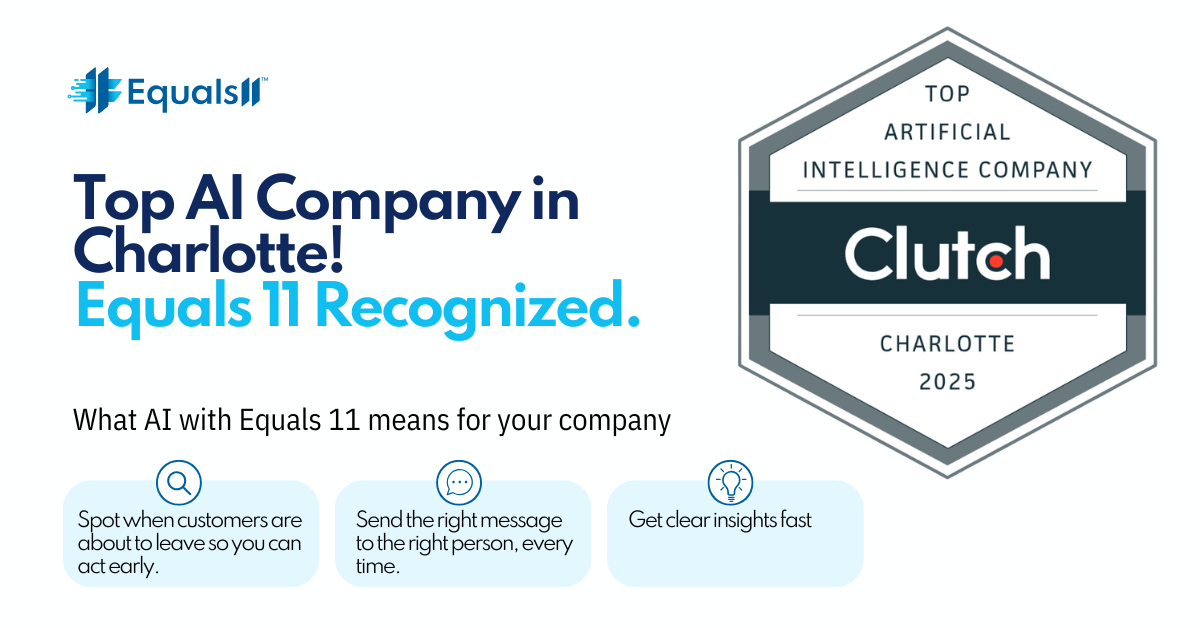
Equals11 has been recognized as a top-rated Salesforce consulting partner for three consecutive years, and in 2025, every client engagement resulted in a 5-star review. That consistency reflects our commitment to building systems that support real business outcomes.
A perspective for business leaders
Choosing a Salesforce consulting partner shouldn’t be based on promises alone. The right partner listens carefully, challenges assumptions, and designs Salesforce in a way that supports how your teams actually work and how leaders make decisions. Salesforce is an operational system that shapes data trust, visibility, and day-to-day execution.
That’s the approach Equals11 takes. We don’t ask business leaders to rely on marketing claims. Instead, we encourage them to look at how our clients describe the value we bring and the outcomes they see after engagement. equals11 has been a top-rated Salesforce consulting partner for three consecutive years, with all client engagements receiving 5-star reviews in 2025.
As one verified client shared:
“Our engagement with Equals11 has been great, and just what we needed. We are a small company with limited resources, and this engagement has helped us make our Salesforce environment more relevant and useful.”
- Healthcare & Life Sciences Client, USA
If we could help reduce the time your team spends working around Salesforce, while improving the information you rely on to make decisions, would it be worth 20 minutes?
Schedule a discovery call with Equals11 to review your Salesforce environment and explore practical next steps.
Frequently Asked Questions
What does a Salesforce consulting partner do?
A Salesforce consulting partner helps organizations design, optimize, and maintain Salesforce so it supports real business processes, reliable reporting, and confident decision-making. This includes improving system design, data quality, automation, and adoption so Salesforce becomes a trusted operational platform rather than just a tool teams log into.
What services do Equals11 and Pisco provide? Across Equals11 and Pisco, services include Quick Start Salesforce implementations, Salesforce optimization, data model improvement, reporting and dashboard design, automation cleanup, adoption support, post-implementation hypercare, and ongoing managed services. Engagements are tailored to an organization’s size, complexity, and immediate priorities, ensuring teams receive the right level of support without unnecessary overhead while still building a foundation that can scale.
When should a business work with a Salesforce consulting partner?
Businesses typically benefit from a Salesforce consulting partner when Salesforce adoption is low, reporting is unreliable, teams rely on manual workarounds, or the system no longer reflects how the business actually operates. Many organizations also engage partners after an initial implementation to optimize and clean up their Salesforce environment.
What makes Equals11 different from other Salesforce partners?
Equals11 focuses on simplifying Salesforce, improving data trust, and enabling better decisions for business leaders. Rather than prioritizing feature delivery alone, Equals11 emphasizes clarity, thoughtful system design, and long-term value. We specialize in working with existing Salesforce environments and have been a top-rated Salesforce consulting partner for three consecutive years, with all client engagements receiving 5-star reviews in 2025.
Does Equals11 support existing Salesforce implementations?
Yes. Equals11 specializes in optimizing Salesforce environments that are already live. This includes org audits, data cleanup, reporting improvements, adoption challenges, post-implementation optimization, and ongoing support to help organizations get more value from the Salesforce platform they already have.
What is Pisco, and how is it related to Equals11?
Pisco is a services brand created by Equals11 to support teams that need focused, practical Salesforce support without the complexity of large-scale transformation programs. While Equals11 often works on broader optimization and strategic initiatives, Pisco is designed for organizations looking for streamlined Salesforce support, targeted improvements, and faster execution within a clearly defined scope.
