
What’s the difference between Salesforce implementation and managed services?
Most Salesforce programs do not struggle during implementation. They struggle after go-live.
At launch, the system works. Core workflows are live, reports exist, and users are trained well enough to operate day to day. On paper, the project is a success.
The problems start quietly months later, when the business begins to change but the Salesforce org does not evolve with it.
At Equals 11, we consistently see organizations invest heavily in implementation, then dramatically underinvest in what happens next. Budgets are approved, executive sponsors are engaged, and partners deliver exactly what was scoped. Once the system is live, ownership shifts internally, and support becomes reactive, fragmented, or deprioritized altogether.
That is a misunderstanding of where Salesforce value actually comes from.
To avoid this trap, it is critical to clearly distinguish Salesforce implementation from Salesforce managed services, because they serve fundamentally different purposes.
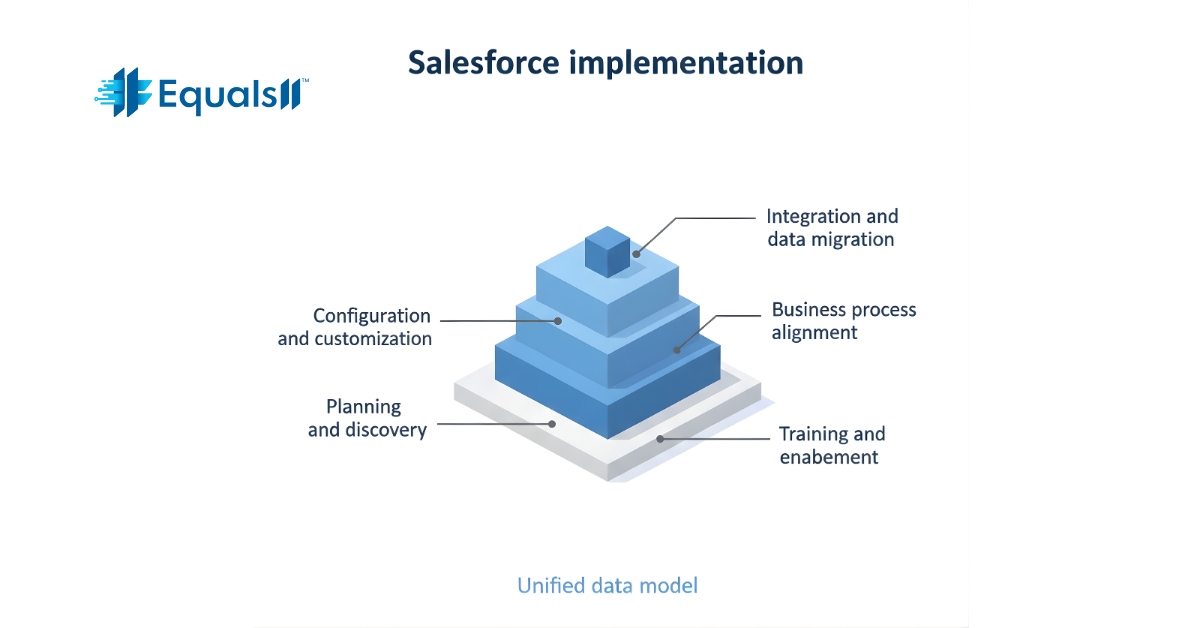
What Salesforce implementation is (and what it is not)
Salesforce implementation exists to establish a usable system based on current business requirements.
Its role is to translate known processes into Salesforce architecture. This includes designing the data model, configuring objects and automations, setting up security and access controls, integrating with surrounding systems, and enabling users to operate within defined workflows.
A strong implementation delivers stability and clarity at a specific moment in time. It answers whether the organization can run its core operations in Salesforce today, using today’s assumptions, processes, and reporting needs.
By design, implementation is finite. Once the system is live, stable, and adopted at a baseline level, the implementation phase ends. That does not mean Salesforce is finished. It means the foundation has been poured.
Where most organizations go wrong after go-live
The biggest risk to Salesforce value is assuming that go-live represents completion.
In reality, the business continues to evolve almost immediately. Teams request changes as they encounter edge cases. Data volumes increase and expose early modeling shortcuts. Leaders ask for insights that were not part of the original scope. Users create workarounds that slowly bypass the intended design.
At the same time, Salesforce releases three major updates every year. These updates introduce new capabilities, shift best practices, and occasionally deprecate older functionality. They affect automations, security models, reporting behavior, and integrations, whether an organization plans for them or not.
Without structured post-implementation ownership, these pressures accumulate quietly. The system still works, but trust erodes. Reporting accuracy declines. Enhancements become harder and more expensive to deliver. Eventually, leadership questions the ROI of Salesforce, not realizing the issue is not the platform but the lack of ongoing stewardship.
This is exactly the gap managed services are designed to fill.
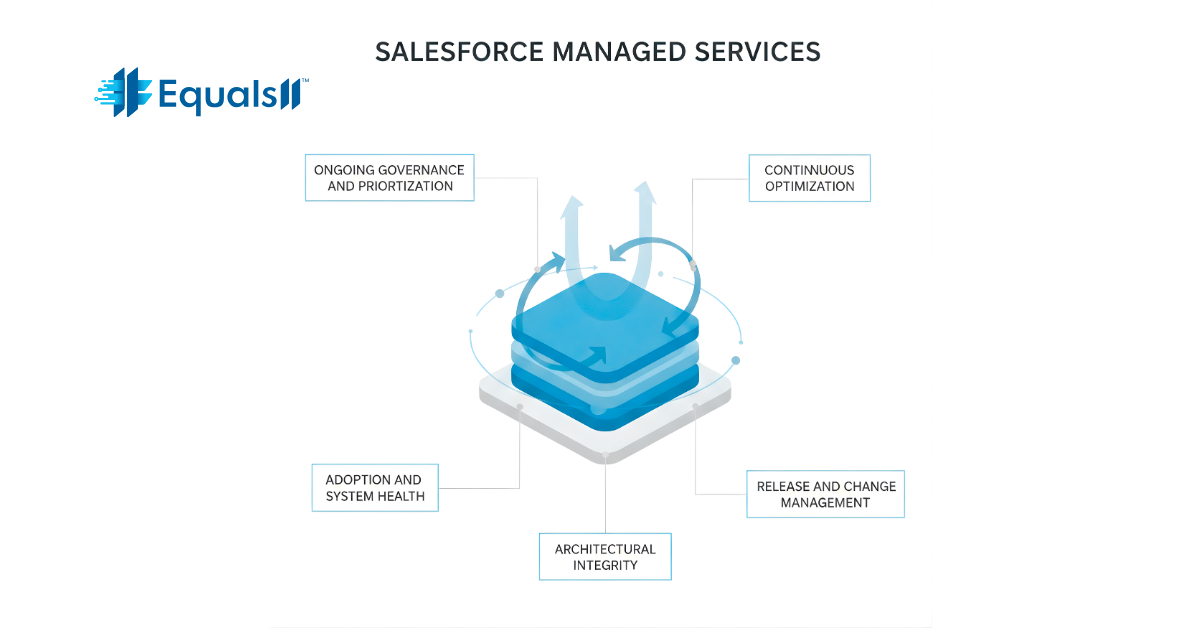
What Salesforce managed services actually do
Salesforce managed services are not a help desk and not a collection of ad hoc fixes.
Their purpose is to protect the architectural integrity of the org while allowing it to evolve. Managed services ensure that changes align with business priorities, that adoption keeps pace with system capability, and that short-term requests do not create long-term debt.
A mature managed services model treats Salesforce as a living system. It introduces ongoing prioritization, governance, and optimization so the platform continues to deliver better outcomes over time, not just more features.
In practice, managed services answer a different question than implementation ever could.
Is Salesforce still helping the business operate more effectively and make better decisions than it did last quarter?
Implementation creates value. Managed services compound it.
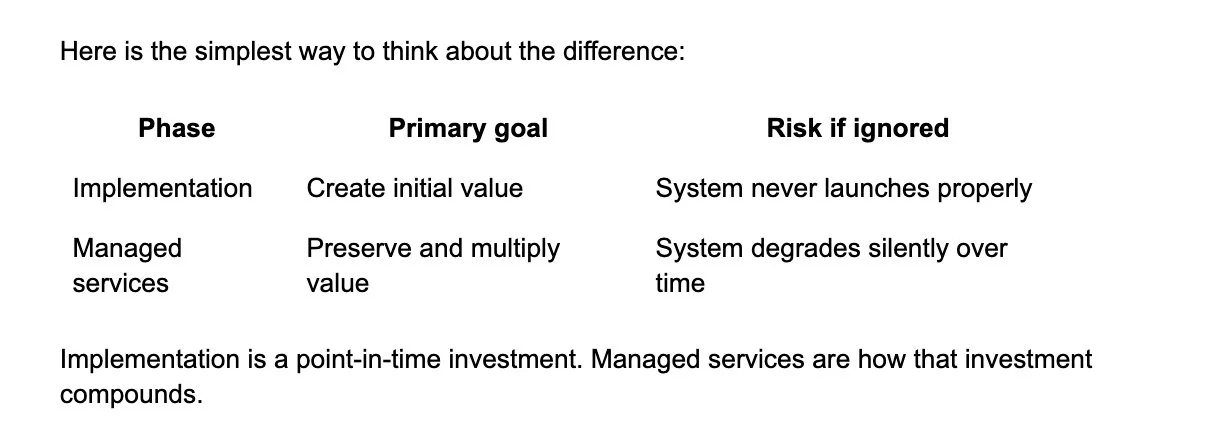
Without managed services, small changes accumulate into technical debt. Data quality declines gradually. Teams lose confidence in dashboards and fall back on spreadsheets. Eventually, organizations face expensive cleanup projects that could have been avoided entirely.
With the right managed services model in place, Salesforce evolves alongside the business. Enhancements remain intentional. Data remains trustworthy. Leaders can rely on Salesforce as a decision system, not just a CRM.
Real-world example from Equals 11
An enterprise organization engaged Equals 11 several months after a successful Salesforce implementation. While the system was live, leadership had lost confidence in reporting, and change requests were piling up without clear ownership.
Through a managed services engagement, Equals 11 re-established governance, aligned reporting to the core data model, and introduced structured prioritization and release reviews. Within a quarter, executive trust in Salesforce was restored, and the organization avoided a costly reimplementation.
What clients say about Equals 11 managed services
“Equals 11 was engaged to evaluate our Salesforce native prototype and craft a roadmap for turning it into a commercial offering. Their blend of product strategy and deep technical expertise produced clarity and insights no other partner had provided.” - Verified Salesforce AppExchange Review. View more actual reviews from our clients here.
Salesforce works best when someone is actively stewarding it.
If you want an objective perspective on whether your org is evolving in the right direction, would a 20-minute conversation with a Salesforce expert be worth your time? Schedule a discovery call here.
