
What Open CTI retirement means for your business
A Salesforce admin opens the release notes and finds a single line that reshapes the next two years of the roadmap. Open CTI, the framework that has connected the company's phone system to Salesforce since go-live, now has a retirement date. February 28, 2028.
If your service or sales reps work a phone panel that lives inside Salesforce, this affects you, and the clock has already started.
What Open CTI is, and what is actually changing
Open CTI is the Salesforce API that lets a third-party telephony system plug into the Salesforce interface. It powers the everyday things reps rely on without thinking about them: the screen pop when a call comes in, click-to-dial from a record, and call controls inside the console. For years, it has been the standard bridge between the phone and the CRM.
That bridge is being removed. Open CTI is in maintenance mode today, which means no new features and no enhancements. Salesforce has also stopped allowing net new Open CTI implementations. Existing setups keep working until the retirement date, and then they stop functioning. There is no extension built into that timeline. After February 28, 2028, the integration goes dark.
Why Salesforce is retiring it
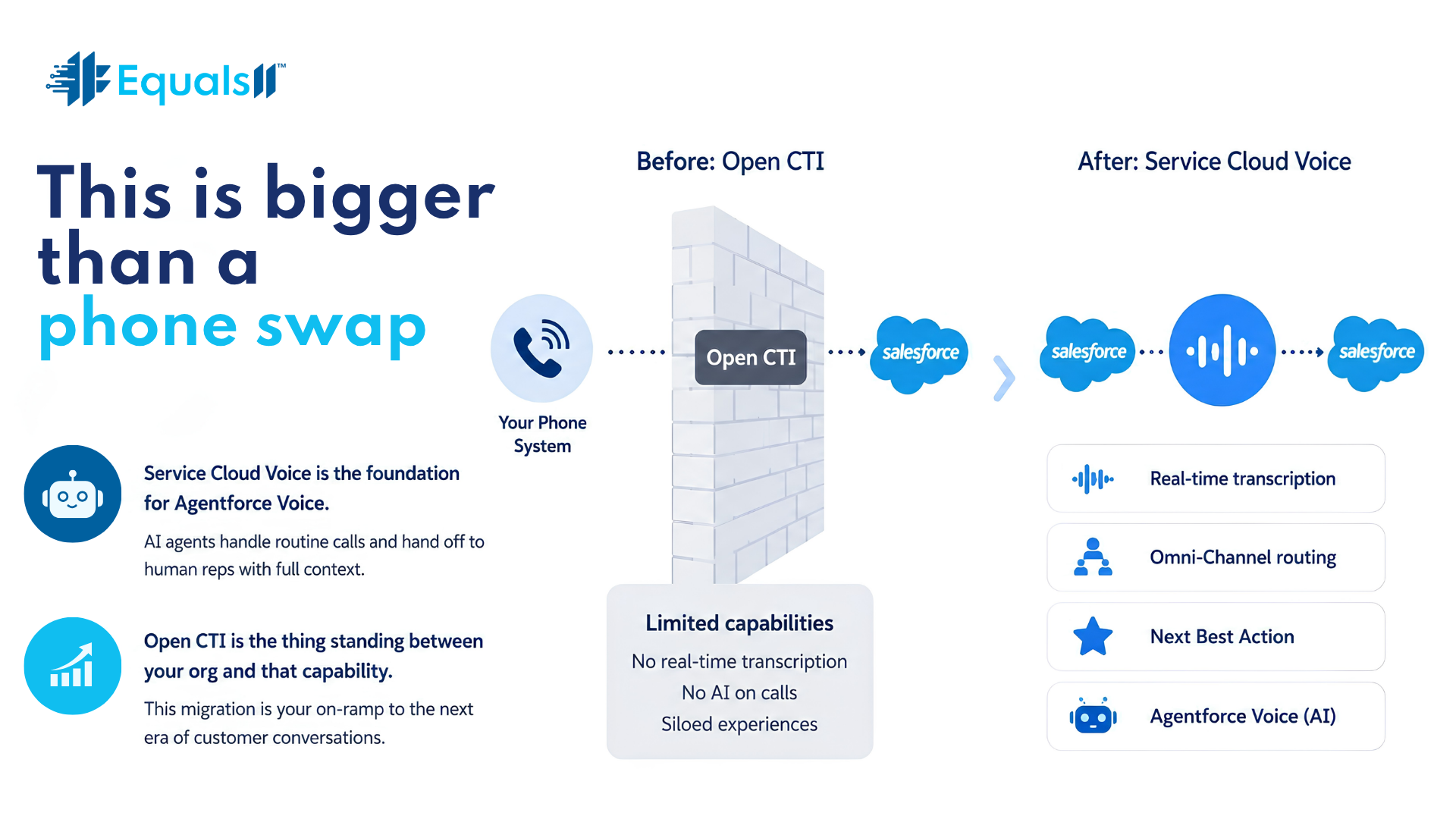
Salesforce is consolidating voice onto Service Cloud Voice, its native telephony product. The reason is straightforward. A bolted-on integration cannot deliver the things Salesforce is now building around the call. Service Cloud Voice brings the phone channel inside the platform, which is what makes real-time transcription, Omni-Channel routing, Next Best Action, and AI on live calls possible. Open CTI was built for an earlier era. Service Cloud Voice is where the investment is going.
This is bigger than a phone swap
Read the retirement notice as a telephony task, and you will miss the point. The migration off Open CTI is the on-ramp to Agentforce Voice, the AI voice layer Salesforce introduced with Agentforce 360. AI agents that handle routine calls and then hand off to a human rep with full context intact only become possible once you are on Service Cloud Voice. Open CTI is the thing standing between your org and that capability.
So the real question is not how to replace a softphone. It is whether you use this forced move to set up the next several years of customer conversations, or whether you rebuild the same constraints on a new foundation.
Waiting is the expensive choice
February 2028 reads as far away. It is not. A voice migration touches routing logic, integrations, agent workflows, reporting, and live customer traffic, which means it has to be scoped, tested in a sandbox, and cut over without dropping calls. In our experience, these projects run six to twelve months once you account for the full cycle. Starting in 2027 is starting late, and a rushed cutover is where disruption and missed opportunities show up.
The right way to approach it
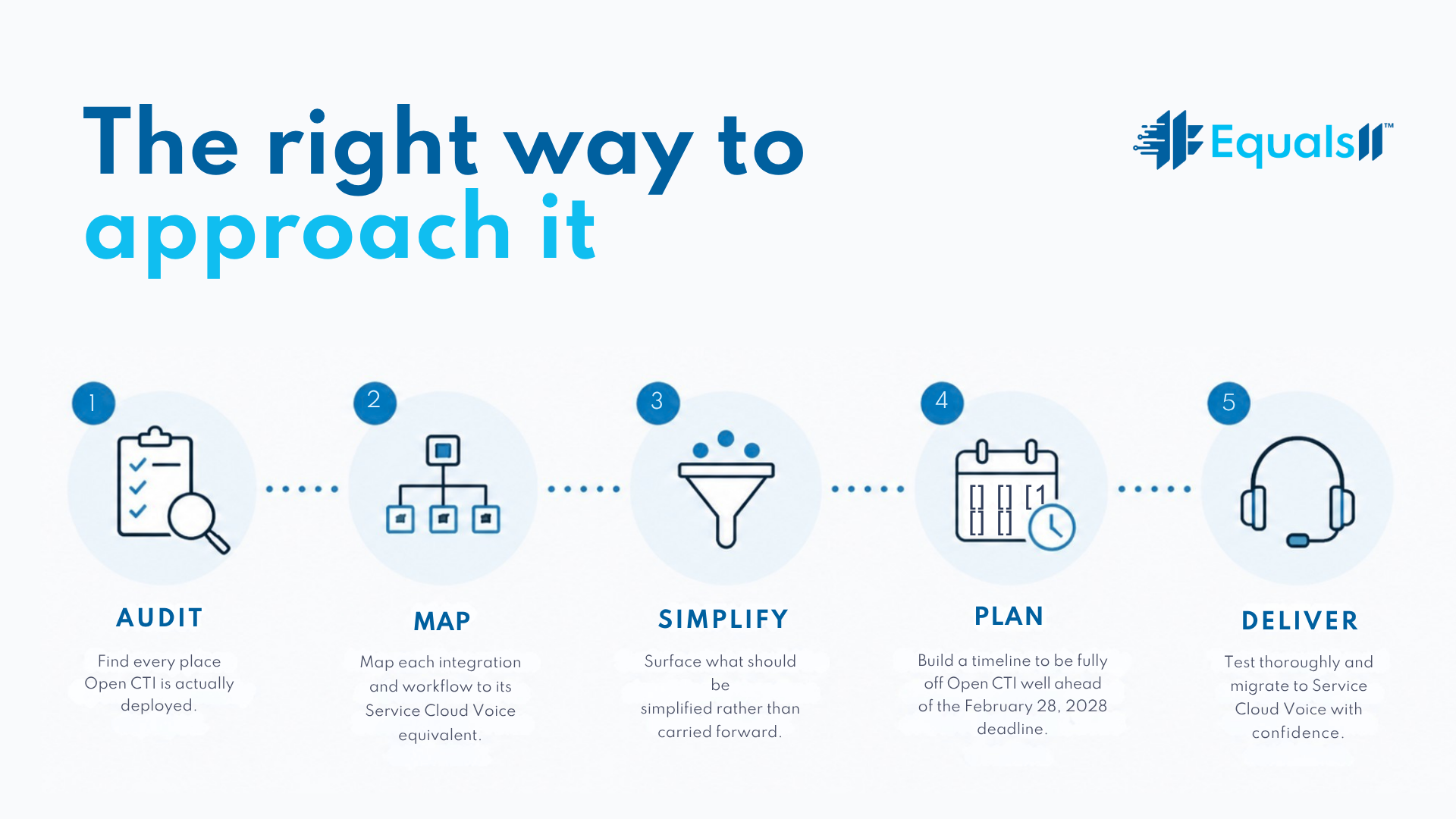
The instinct under a deadline is to lift and shift. Move the phones, keep everything else, get it done. That instinct is how a messy org becomes a messy org on a more capable platform.
A cleaner approach starts with an audit. Find every place Open CTI is actually deployed, because deployments spread quietly over the years, and the real footprint is usually larger than anyone remembers. From there, map each integration and workflow to its Service Cloud Voice equivalent, and use that mapping to surface what should be simplified rather than carried forward. Then build a timeline that lands you fully off Open CTI well ahead of the deadline, with room to test.
This is the same principle that Equals11 applies to every engagement. Get the data and architecture right before you add the automation and the AI on top. The migration is the rare moment you have a budget and a mandate to fix what is underneath, and skipping that step is how AI ends up running on data it cannot trust.
Where Equals11 fits
Equals11 is a certified Salesforce partner focused on what happens after implementation. We run the Open CTI migration to Service Cloud Voice and get your data model, integrations, and governance ready for Agentforce, so the move forward is clean, and the AI works on day one. The deadline is fixed. The quality of what you build between now and then is the part you still control.
Frequently asked questions
When is Open CTI being retired?
Salesforce has set the Open CTI end of life for February 28, 2028. The framework is already in maintenance mode, so no new features are being added, and no new implementations are permitted. Existing integrations continue to function until the retirement date, after which they stop working entirely.
What is replacing Open CTI?
Service Cloud Voice is the replacement. It brings telephony natively into Salesforce instead of connecting it through an external adapter. That native model is what enables real-time call transcription, Omni-Channel routing, Next Best Action, and the AI capabilities in Agentforce Voice, none of which the legacy Open CTI framework can fully support.
Do I need to migrate if my Open CTI setup still works today?
Yes. A working setup today does not change the deadline. After February 28, 2028, Open CTI implementations no longer function, regardless of how stable they are now. Planning early gives you time to audit, test, and cut over carefully rather than rushing a high-stakes migration against a hard stop.
How long does an Open CTI migration take?
It depends on the size and complexity of your environment, but most migrations run six to twelve months once you include the audit, sandbox testing, and a controlled cutover. Voice touches live customer traffic, so the timeline has to leave room for testing rather than a same-week switch.
Is Service Cloud Voice required for Agentforce Voice?
Service Cloud Voice is the foundation that Agentforce Voice runs on. Moving off Open CTI is the prerequisite for the AI voice features Salesforce is building, including AI agents that handle calls and hand off to human reps with full context. The migration is less a phone upgrade and more an Agentforce readiness step.
See whether your org is ready for what comes after the migration. Book a call here.
