
How a nonprofit Salesforce data cleanup pays down data debt
The board meeting is in three days. Your executive director needs one number. How many active donors gave this year? Development pulls it from campaigns. Finance reads it from deposits. The grant writer building a funder report lands somewhere else. Same Salesforce org, three answers, and now you are reconciling by hand the night before.
Nobody did anything wrong. The data stopped telling one story a long time ago, and every team learned to read it a little differently. That gap has a name. Call it data debt, the slow buildup of duplicate constituents, empty fields, and records nobody ever defined, which taxes every report you send to a board or a funder. A nonprofit Salesforce data cleanup is how you pay it down before it starts shaping decisions you did not mean to make. We have written before about technical debt and knowledge debt, the quiet costs that accumulate inside an org while everyone is busy. This is the nonprofit version.
What data debt costs you first: trust at the board table
For a business, messy reporting is an internal annoyance. For a nonprofit, it walks straight into the room where your funding gets decided.
When the active-donor number cannot survive a second look, your executive director stops trusting the dashboard and asks development to rebuild it by hand. The board sees a figure, asks a fair question, and the answer is a pause. That pause costs you credibility you spent years earning. Leadership starts treating Salesforce as a place where data goes in, not a place where answers come out. The most expensive CRM decision a nonprofit can make is quietly deciding to stop believing in its own system.
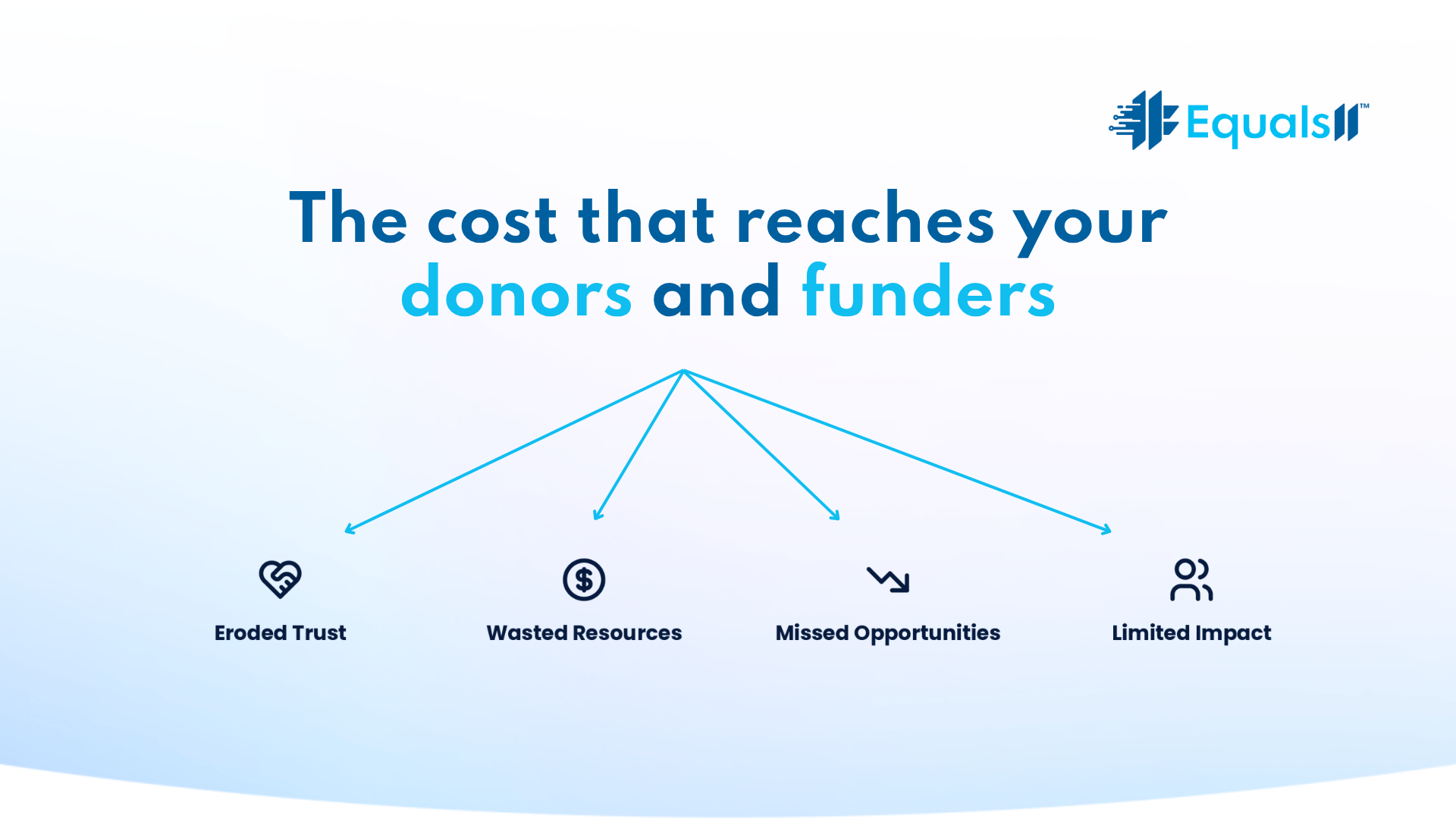
How dirty donor data reaches your donors and funders
This is where nonprofit data debt does damage that a sales team never has to think about.
A duplicate constituent record means the same supporter gets the year-end appeal twice. Or gets thanked for a gift they never made. Or gets asked for a first-time donation the same week they renewed at a higher level. To that donor, it does not read as a data issue. It reads as a charity that does not actually know them. Your development team can spend two years cultivating a major donor, and one careless acknowledgment undoes a lot of it.
Funders feel it from the other side. A grant report built on numbers that do not reconcile against your own financials reads as sloppiness. When renewal season comes, and a program officer is deciding who still deserves the money, sloppiness is a real risk. Clean constituent data is not back-office hygiene. It is part of how you keep the trust that funds the mission.
Why your last Salesforce cleanup did not stick
Someone on your team probably already tried to fix this. They ran a dedupe, merged a pile of records, and the org felt clean for a quarter. Then the duplicates came back. The reason is almost never effort. It is the absence of rules underneath the cleanup, so the same records drift back in through the same doors. We break down why that happens, and the matching and governance setup that stops it, in our post on why duplicate records keep coming back. The short version for a nonprofit: cleanup without governance is a chore you repeat forever.
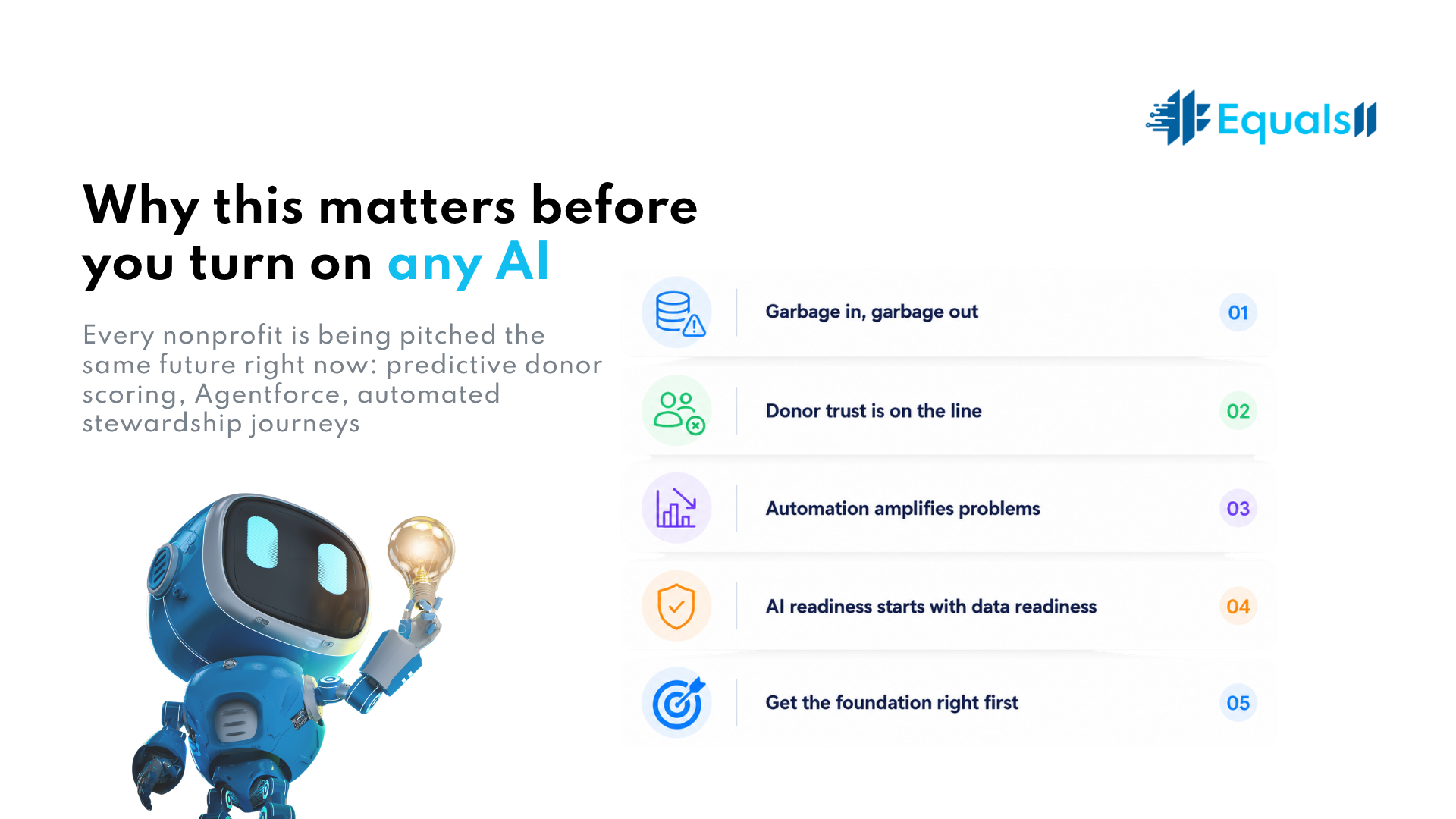
Why clean data has to come before any AI
Every nonprofit is being pitched the same future right now. Predictive donor scoring. Agentforce. Automated stewardship journeys. All of it learns from the constituent data already sitting in your org. Point a model at duplicate supporters and inconsistent giving history, and it will reach confident conclusions that are simply wrong. We walked through that exact failure in why Salesforce churn predictions miss real risk.
For a nonprofit, a wrong prediction is not abstract. A scoring model trained on dirty data can flag a loyal monthly giver as a lapse risk and bury a real major-gift prospect because their record was split into three. Clean data is the entry fee for any AI worth turning on. There is no version where a nonprofit skips it and gets a good result.
What a nonprofit Salesforce data cleanup actually involves
A cleanup is data quality work, not an architecture rebuild. You deduplicate constituents and merge the records that describe one real person. You standardize how gifts, households, and constituent types are recorded so a number means the same thing in development, in finance, and in a grant report. You write down the rules that were never written. What counts as an active donor? What counts as lapsed? Who owns each field?
Then you set the governance so the org stays clean instead of drifting back into debt by next fiscal year. There is one case where cleanup alone will not hold. If you have cleaned the same records year after year and the mess still returns even with rules in place, the problem is usually structural. That is a different decision, and we cover it in Salesforce data cleanup vs. data redesign. For most nonprofits, the foundation is sound. The data just needs cleanup, plus the rules to keep it that way.
Frequently asked questions
How do I clean up a messy Salesforce org for a nonprofit?
Start by finding duplicate constituents and merging the records that describe one real supporter. Then standardize how gifts and households are recorded, define what active and lapsed mean for your organization, and give each key field an owner. Finish with governance rules so the data stays clean. Cleanup without governance is a task you will repeat every fiscal year.
Why don't our donor numbers match across teams?
Because each team counts from a different slice of the same messy data. Development pulls from campaigns, finance from deposits, and a grant writer from a report filter, and duplicate or undefined records mean those slices never line up. The fix is one agreed definition of an active donor, applied across the org, so every team is finally counting the same thing.
Should nonprofits clean their data before using Salesforce AI tools?
Yes, and it is not optional. Predictive donor scoring and Agentforce learn from the constituent data already in your org. Feed them duplicate supporters and inconsistent giving history, and they will produce confident, wrong answers, like flagging a loyal donor as a lapse risk. Cleaning the data first is what makes any AI investment actually help the mission.
How long does a nonprofit Salesforce cleanup take?
It depends on how deep the debt runs. A focused cleanup of donor records, households, and your core giving reports usually takes a few weeks. A full pass across every program, field, and automation runs longer. The pace comes down to how clearly the problems are mapped before the work starts, which is why a diagnostic always comes first.

Where should our nonprofit start with a cleanup?
Map the problem before you touch a single record. A short call with someone who has cleaned up nonprofit orgs will sort out what is duplicate, what is undefined, and what is structural, so you fix the right things in the right order instead of guessing. Book a 20-minute nonprofit strategy call at equals11.com/contact, and we will map where to start.
Salesforce is not expensive. Misalignment is.
