
Why your Salesforce opportunity stages don't line up
There is a meeting on Monday morning where someone goes through the deals marked Closed Won and decides which ones are actually closed. Nobody scheduled it as a permanent fixture. It started as a temporary check during a messy quarter, and it never came off the calendar.
That meeting is what a definition gap costs. Sales marks the stage when the contract is signed. Finance counts it when the deposit clears. Delivery starts when kickoff is booked. One picklist value. Three different beliefs about what is now true. Until those reconcile, the business runs a manual verification layer on top of its own system of record, and salaried people spend part of every week confirming that Salesforce is telling the truth.
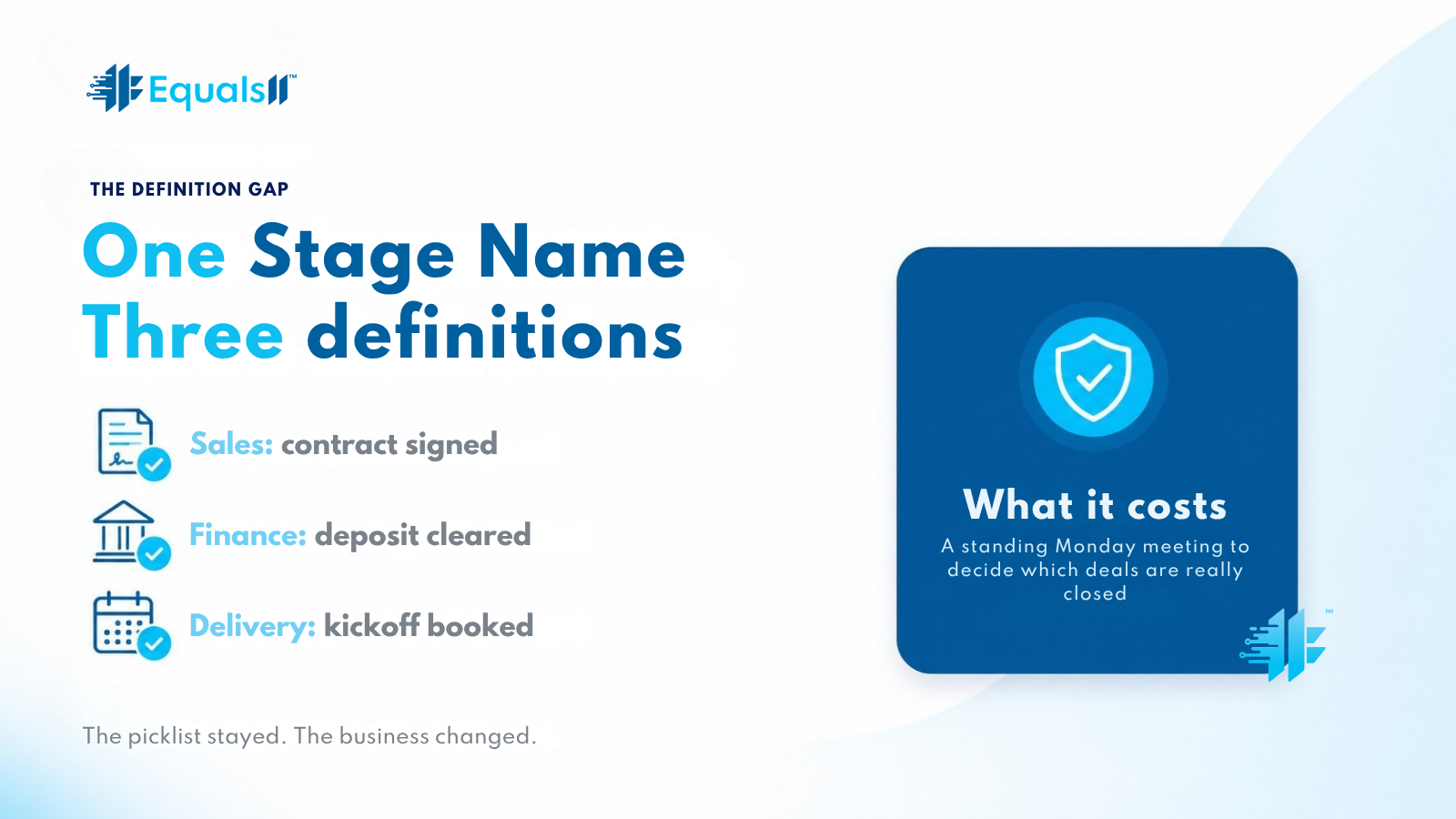
The definitions were written once and never revisited
Stage criteria usually get set during implementation, in a room with a handful of people, against how the business worked that year. Then the business changed. New segments came in, a service line got restructured, deal shapes shifted. The picklist stayed.
What follows is not confusion. Each team develops its own private rule for when the stage is trustworthy, and the rules diverge quietly. Finance builds a confirmation step. Delivery waits for a signal outside the system. The stage stops being a fact and becomes an opinion that has to be checked.
The cost is that Monday meeting, permanently, plus every downstream plan built on a date that is off by a week. Services capacity gets forecast against the wrong start. Revenue recognition slips.
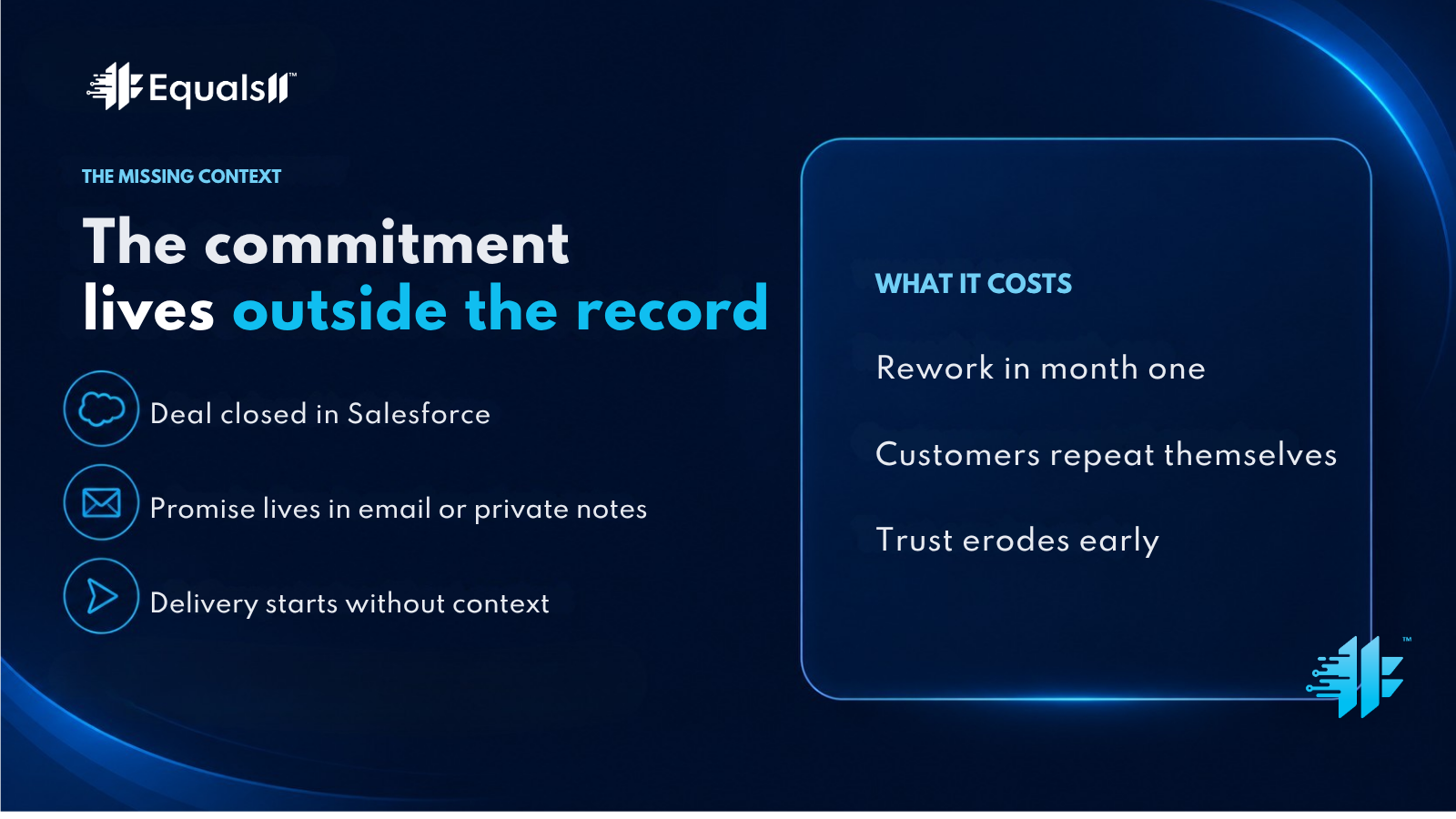
The commitment lives outside the record.
The opportunity says a deal closed. It does not say what was promised. Scope caveats, the pricing exception approved on a call, the customer's real go-live constraint- all of it sits in email or a spreadsheet the rep keeps privately.
This is a close cousin to shadow CRM, and we covered that pattern separately. The difference here is narrower. Shadow CRM is where a team keeps its own version of the pipeline. This is where the promise itself goes unrecorded, so delivery inherits a status and no context. When the rep leaves, the promise leaves too.
The cost is rework in the first month of every engagement, and a customer who explains their requirements to three different people before anyone gets it right. That shows up in renewal conversations long after anyone remembers the cause.
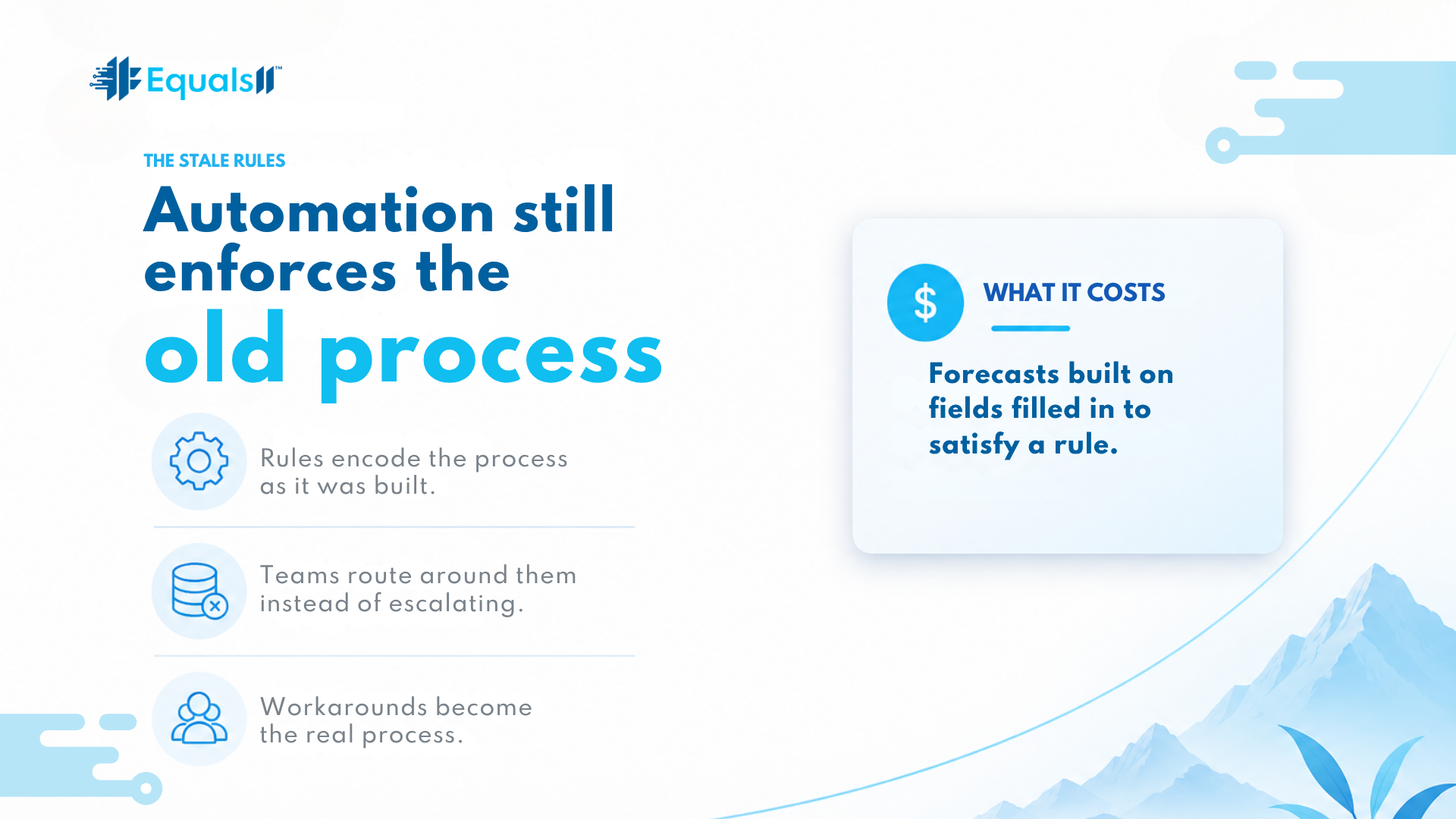
Automation still enforces the old process.
Validation rules and Flows encode the stage logic as it was built. Teams do not escalate when it stops fitting. They route around it. They pick the record type that lets the deal through, or drop a placeholder into the required field so the rule clears.
Every workaround makes sense for the person doing it. Together they produce data that describes a process nobody follows. If Flow sprawl is already in the org, several abandoned versions of the process are being enforced at once, and nobody can say which rule wins.
The cost is planning data you cannot trust. Forecasts and headcount decisions draw on fields that were filled in to satisfy a rule rather than to describe what happened.
Agents inherit the disagreement.
An agent cannot tell that Closed Won is unreliable until finance confirms it. It reads the field, treats it as fact, and acts at more points in the workflow than a person would. We wrote about why Agentforce fails on a messy org in more depth, and stage definitions are one of the foundations that has to settle first.
What fixing it takes
Write down what each stage means to every team that reacts to it, then reconcile the versions into one. That conversation is short, mildly uncomfortable, and it clears more downstream noise than any technical change. Move the commitments into structured fields so the stage carries information rather than just a status. Retire the automation built for the old process. Then put the handoff on someone's scorecard, because right now it sits between three leaders and belongs to none of them.
None of that is complicated to describe. It is hard to finish, since it crosses departments and competes with whatever each team is already measured on. That is why the Monday meeting is still on the calendar.
That is the part Equals11 owns. Baseline finds where the definitions diverge and what each gap costs, with evidence instead of opinion. eLabs rebuilds the automation to match how the business runs now. Continuum keeps it aligned as the business keeps changing. The team that maps the gaps is the team that closes them, and the team that holds them closed a year later. One accountable partner, no hand-off risk.
Salesforce is not expensive. Misalignment is.
Frequently asked questions
What are Salesforce opportunity stages supposed to represent?
Each stage should mark one agreed milestone in the deal, with criteria every team accepts. Sales, finance, and delivery all react to the same value, so the definition has to hold across all three. When it does not, each team adds its own confirmation step outside the system.
Why do sales and finance disagree about closed deals?
They apply different tests. Sales treats a signature as the finish line. Finance waits for payment terms or a deposit to clear before the deal counts. The stage never encoded which test governs, so both teams are right by their own rule and the number stays contested.
How do I know if my opportunity stages need work?
Look for workarounds. Placeholder values in required fields, a record type chosen to dodge a validation rule, a standing meeting to review which closed deals are real. Each one signals that the stage no longer describes the process the business actually runs.
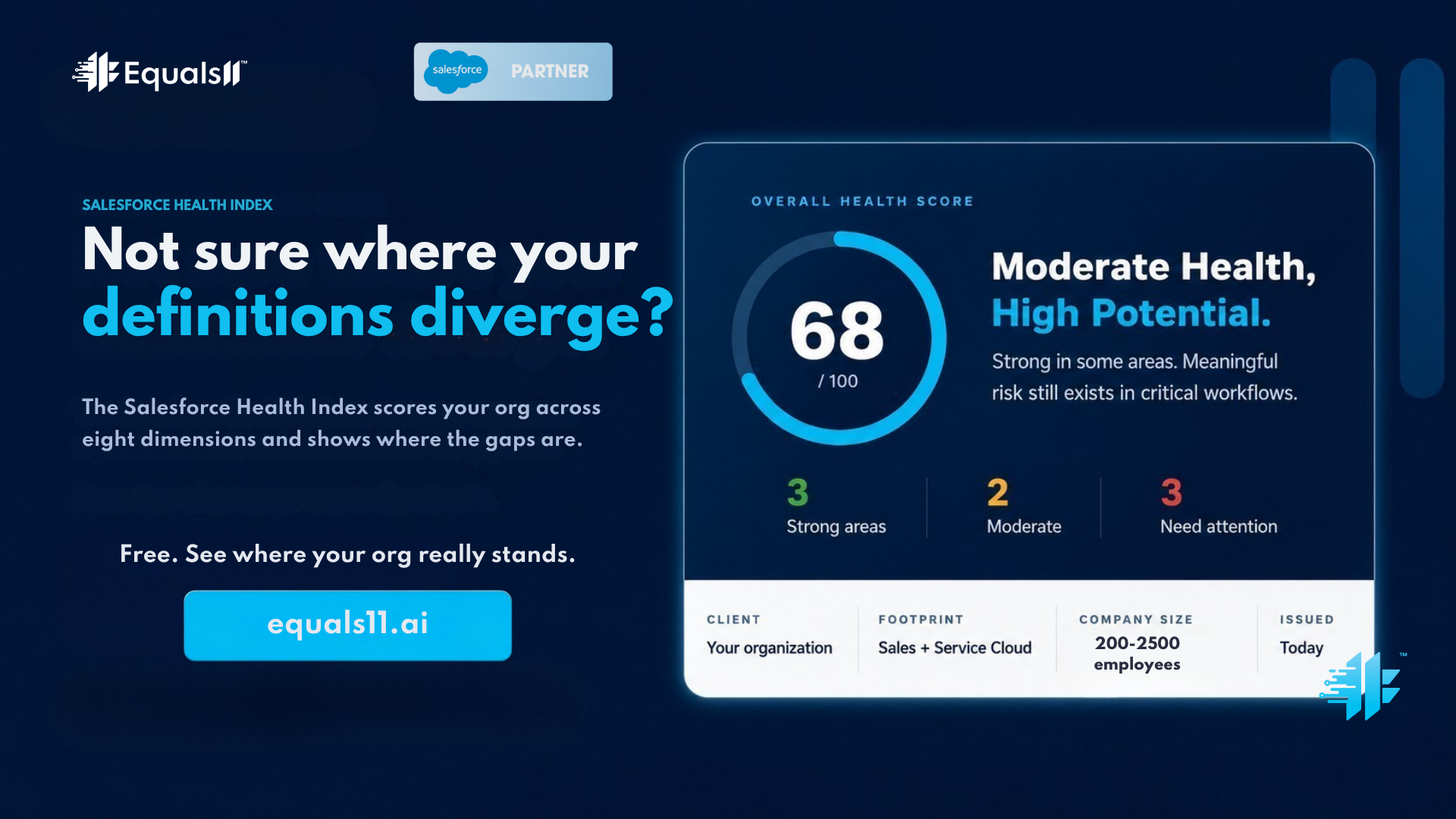
Not sure where your definitions diverge? The Salesforce Health Index scores your org across eight dimensions and shows where the gaps are. Free. See where your org really stands. → Take it at equals11.ai
