
The short answer: 90 days after go-live, “Salesforce is live” usually means the project is closed. Pipeline still doesn’t match Finance, and reps still keep side spreadsheets. What’s missing is governance and a named owner. More features won’t fix that. A No-Cost Baseline shows which failure modes are still burning time before you fund another enhancement wave.
Go-live vs. operating readiness
Go-live is a project milestone. Users can log in, objects and flows are deployed, training has happened, and the implementation partner moves on.
Operating readiness is a higher bar. Leadership can answer “what’s our pipeline?” with one number Finance will defend. Stage exits mean the same thing in every region. Exceptions have an owner and an expiry date, not a Slack thread that dies on Friday afternoon.
For mid-market companies already on Salesforce, this is where money leaks. Gartner has put CRM project failure or underperformance at 50 to 70 percent for years. In the orgs we work inside, that gap rarely opens on launch day. It opens in the months after, when the board has been told the platform is live, and the backlog has quietly grown through hypercare.
Hypercare is short, intensive support. When it ends without governance, the company keeps the tool and loses the scaffolding that made the tool look fine.
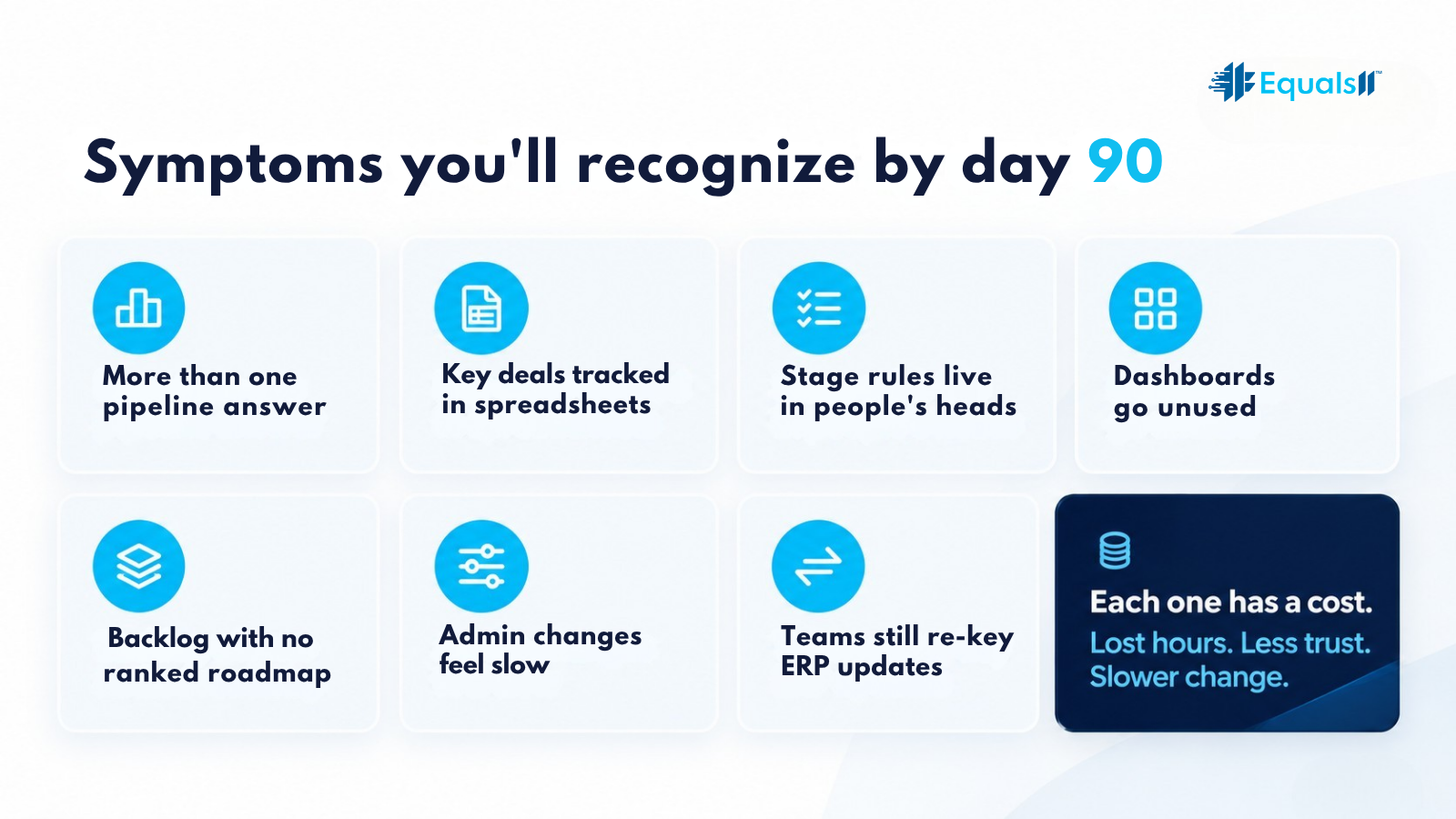
Symptoms you’ll recognize by day 90
The CEO asks for pipeline and gets more than one answer. (We broke down why in our pipeline reports post.)
Deals that matter still get tracked outside Salesforce “just for this quarter.” (More on that in our shadow CRM post.)
Stage names look clean in the UI, but exit criteria live in two managers’ heads.
Dashboards that looked great in the handoff walkthrough go unused in actual QBRs.
Enhancement requests pile up with no ranked roadmap, no capacity plan, and no lane for paying down debt.
Unused custom fields, dead validation rules, and cloned profiles slow every admin change.
The integration “is live,” yet people still re-key status between the ERP and Salesforce.
Seven post-implementation failure modes
Nobody owns the operating model. The implementation team left. Tickets have queues, but nobody owns definitions, inspection, or the right to say no.
Pipeline was never defined with Finance. Pipeline, forecast, and booked revenue mean different things to different teams. Reports were accepted as a stand-in for agreement.
Training happened. Behavior didn’t. Completion rates get celebrated while the spreadsheets survive, because leadership still accepts them in forecast meetings.
Profiles were cloned to ship fast. Those clones become next year’s audit finding and the first thing to block an Agentforce rollout.
People are the integration. Both systems “work,” but staff still act as human middleware between the ERP and Salesforce. That costs hours every week, and the data in Salesforce is always a step behind.
Roadmap by loudest voice. With no scorecard for business value or technical debt, the backlog turns into a political document.
Hypercare hangover. Temporary exceptions like open permissions, skipped validations, and manual jobs quietly became permanent.
Each one has a cost you can count. Analyst hours go into reconciliation. Forecasts get built on numbers nobody trusts. Admin time goes to workarounds instead of improvements.
What good looks like
Within a quarter of go-live, or of any major release, you should be able to show:
One pipeline definition signed off by the CRO and Finance
Written, inspectable exit criteria for each stage
A named internal owner for Salesforce health, by role
A quarterly technical debt review with three concrete paydown actions
A short, ranked priority list in place of an endless enhancement wish list
We’ve seen this play out in very different orgs. National Kidney Foundation’s VP of IT wanted Salesforce to stop acting as a data repository and start working as a CRM. Getting there took Einstein Prediction Builder plus Next Best Action, so field teams got a ranked list of what to do next instead of a report to read. Care Services, a pharmacy services company, retired major technical debt and built a Fast Track Contracting automation that cut manual onboarding work. Both started with a live Salesforce org that leadership needed to do more. See the case studies.
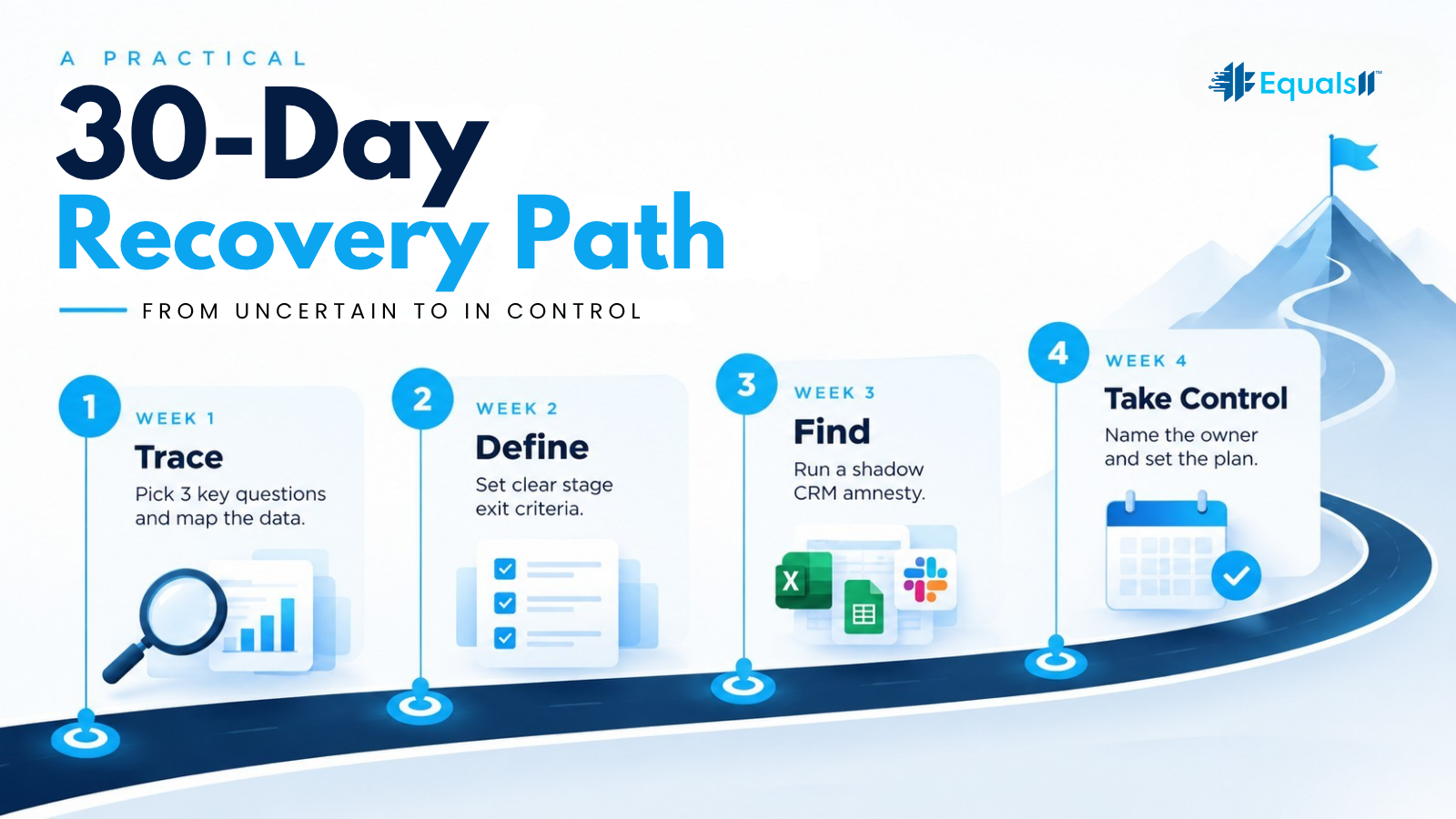
A practical 30-day recovery path
Week 1: Pick the three questions leadership asks in every QBR. Trace each one to its fields and reports, then put the pipeline reports side by side and write down the filter differences. Leave people out of it.
Week 2: Draft exit criteria for your top three revenue stages, one page each.
Week 3: Run a shadow CRM amnesty. Inventory the sheets, Slack lists, and side databases. No witch hunt.
Week 4: Name the operating owner and put the first change forum on the calendar. Then run a No-Cost Baseline before the next enhancement sprint or AI pilot, so the next spend decision is based on real failure modes.
FAQ
Isn’t this just change management?
Change management covers training and communication. Operating readiness covers definitions, ownership, enforcement, and inspection that survive a re-org.
Should we hire another partner for a cleanup project?
Cleanup without an operating model recreates the same gap within months. Assess first. Then decide between a Growth Engine project to fix what’s broken and ongoing ownership through Continuum.
How long does a Baseline take?
A Baseline is a short, focused sprint. It surfaces the failure modes above and gives you a ranked next move, without months of discovery.
We already paid for hypercare. Why are we still unstable?
Hypercare stabilizes incidents. It does not install governance. Those are different jobs.

Start with a No-Cost Baseline
Map what’s broken before you buy more build. Book your No-Cost Baseline with Equals11. If you need lasting roadmap ownership after that, Continuum keeps the team that built your plan running it.
Salesforce is not expensive. Misalignment is.
Jim Marascio is Principal & CEO of Equals11, a certified Salesforce consulting partner specializing in platform and AI strategy, business alignment, and managed services for the mid-market.
