
Should your organization upgrade to Nonprofit Cloud in 2026?
Your board technology committee asked a question last quarter that nobody in the room could answer cleanly. Salesforce keeps announcing AI tools built for the sector, so why can the development team not touch any of them? The answer usually has nothing to do with budget or staff capacity. It comes down to which version of Salesforce your organization runs, and that call was made years ago by someone who has since moved on.
If your donor records live in the Nonprofit Success Pack, the free package Salesforce has given nonprofits for more than a decade, you are in good company, and you are also sitting inside a decision with no deadline attached to it. NPSP is what added households, recurring donations, and allocations to a standard Salesforce org. Salesforce stopped adding features to it in March 2023, when it launched Nonprofit Cloud. NPSP is still fully supported. No end-of-life date has been announced, and no end-of-sale date exists for organizations already on it. Nothing is going to break. That is precisely what makes an NPSP to Nonprofit Cloud migration so easy to postpone, and it is why the conversation gets pushed another year every time it surfaces.
Two things did change, and both are worth understanding before your next budget cycle. Nonprofit Cloud was renamed Agentforce Nonprofit in October 2025, which says more about where the product is headed than any release note would. And since December 2025, the Power of Us program no longer issues NPSP licenses to new applicants. A nonprofit applying for its ten donated licenses today receives Agentforce Nonprofit.
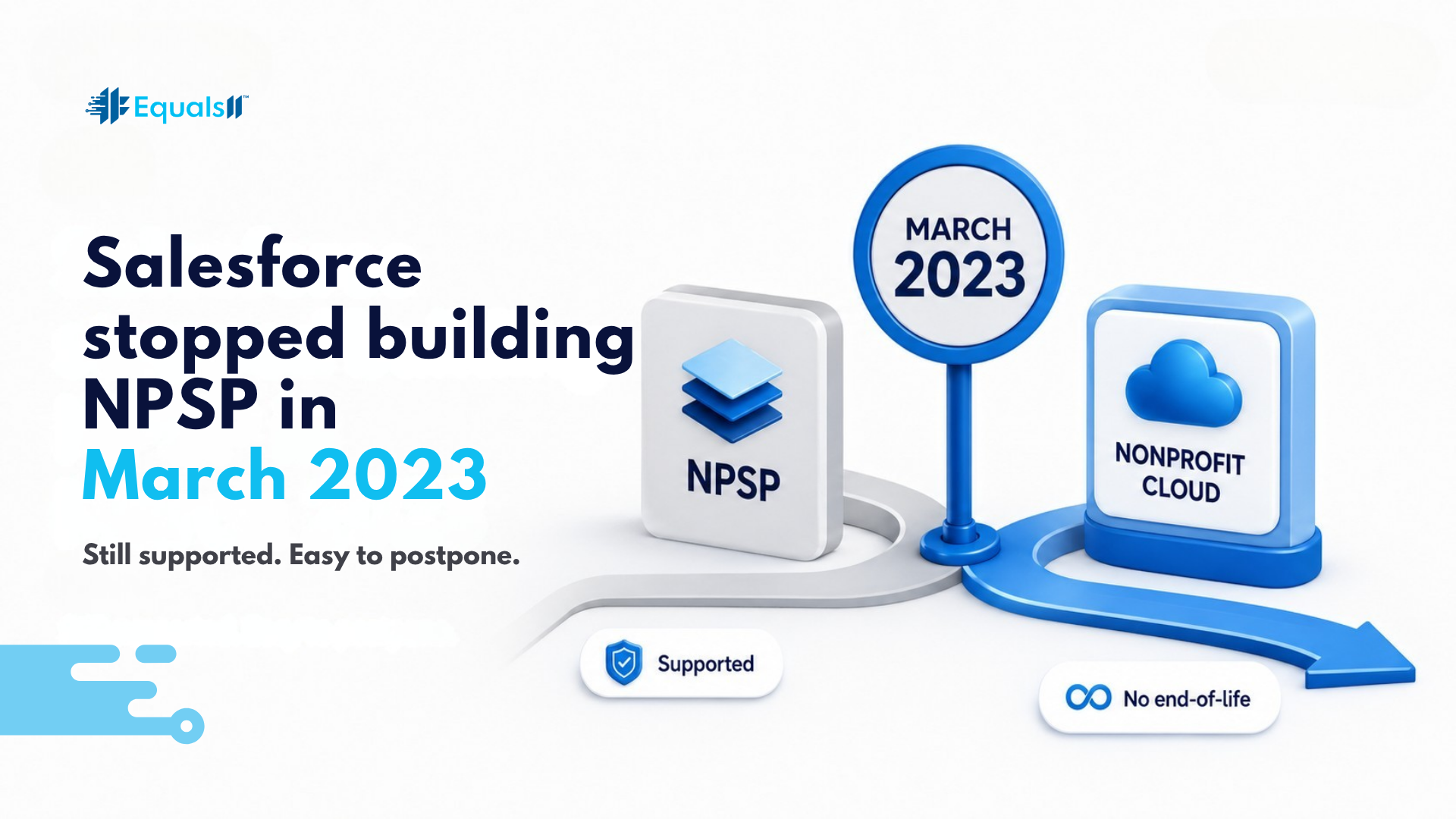
What changed between NPSP and Nonprofit Cloud in 2023
NPSP is a managed package. It sits on top of core Salesforce and adds the objects nonprofits run on, including household accounts, recurring donations, and general accounting unit allocations. That layered design was a real strength for a decade. It also meant every capability Salesforce built into the core platform needed additional work before nonprofit users could reach it, and every seasonal release carried some risk of disturbing the package layer underneath.
In 2023, Salesforce stopped building industry solutions as packages. Nonprofit, healthcare, financial services, and manufacturing were rebuilt natively on the core platform, sharing one data model. Nonprofit Cloud came out of that decision, and it is where every nonprofit feature Salesforce ships now lands first.
The cost of that shows up on your release calendar rather than your invoice. Your admin spends three release windows a year regression testing a package layer instead of improving how program staff record outcomes. Nothing looks broken, which is the trap. The gap between what the platform can do and what your team can actually reach widens quietly, one release at a time, and you pay for it in capability you never get to use.
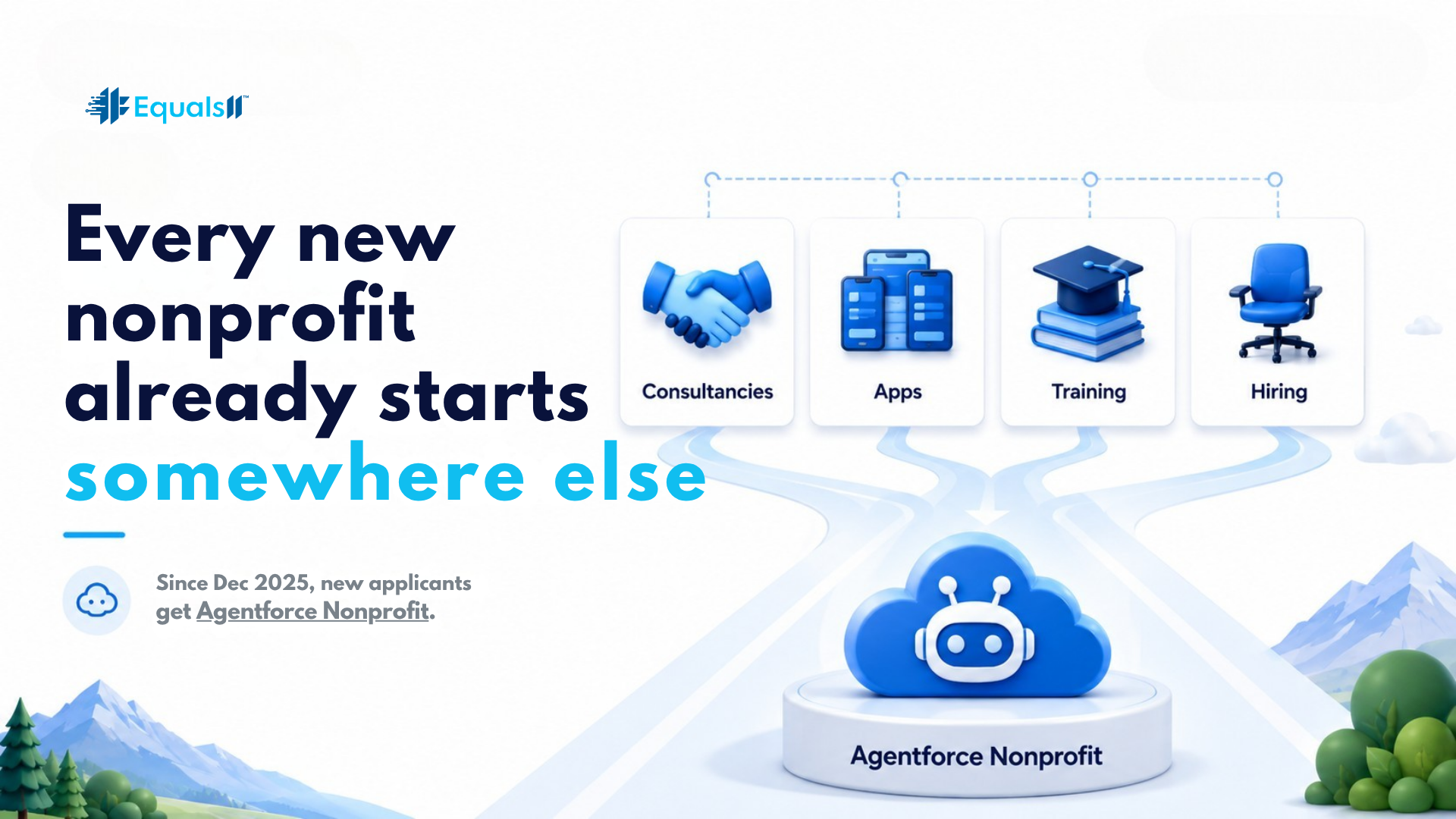
Why the Power of Us license change matters more than it sounds
Every nonprofit entering the Salesforce ecosystem since December 2025 has started on Agentforce Nonprofit. Consultancies build their practices where the new work is. AppExchange vendors prioritize the native data model. Training material and certification content follow the same direction. The admin you interview in three years will have learned on a structure your org does not use.
None of that is urgent this quarter. All of it raises the cost of staying, in ways that never appear as a line item. Support gets harder to source. Apps arrive later, if at all. Onboarding a new hire takes longer because your setup is now the older one. For nonprofits, the total cost was never just the licenses, and this is the same pattern showing up in a different place.
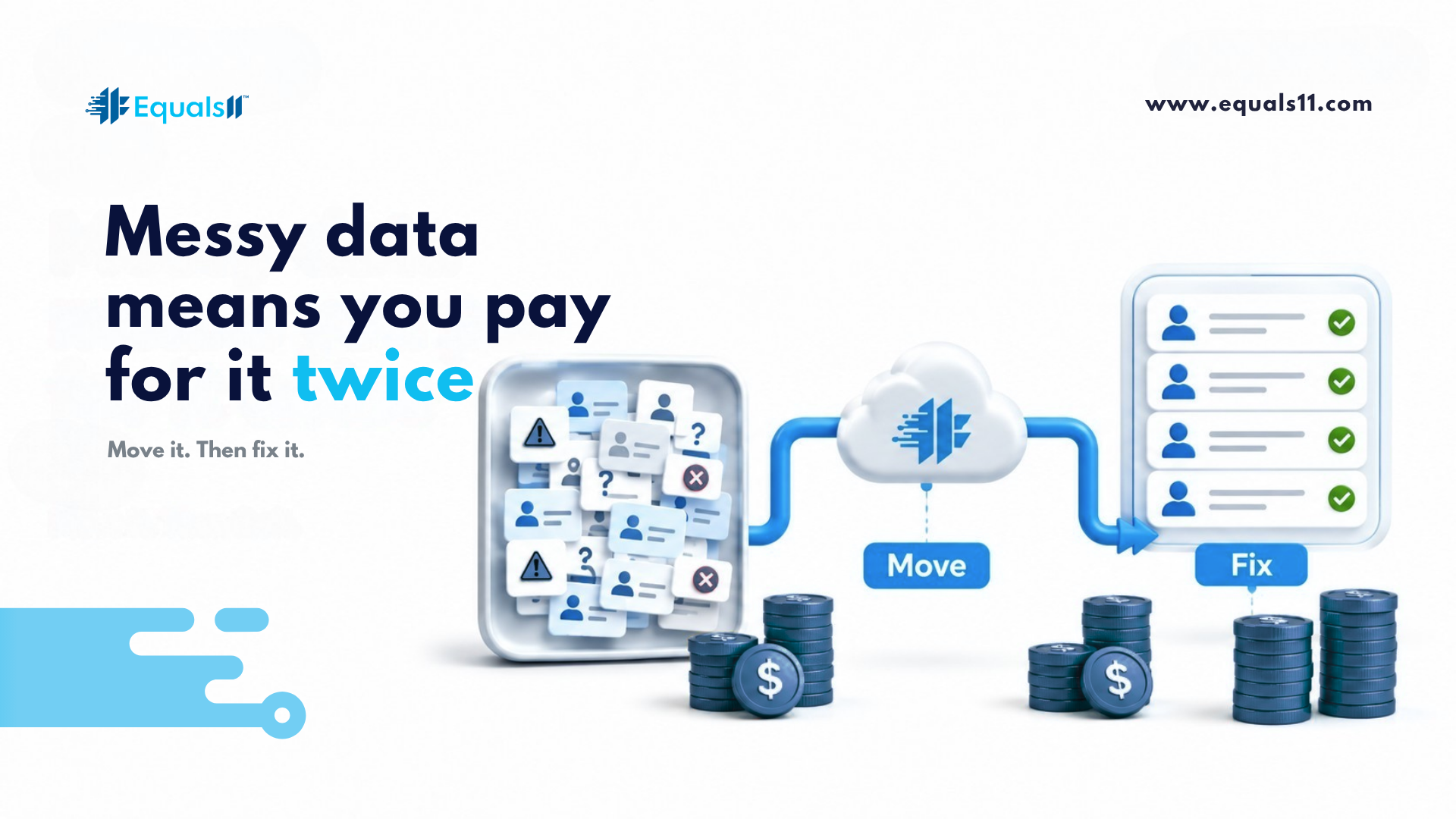
The data model is the real migration project
A move to Nonprofit Cloud is not a lift and shift. NPSP records gifts as opportunities with household accounts sitting underneath them. Nonprofit Cloud uses a different structure for constituents, commitments, and transactions, with program and outcome tracking built into the platform rather than bolted onto it. Your rollups, your reports, your dashboards, and your integrations to the payment processor and the email tool were all written against the old shape.
That makes migration a re-mapping exercise. Every rollup, report, and integration touching an NPSP object needs a decision. Keep it, rebuild it, or retire it. That work is the project, and it is where the budget goes.
There is a financial consequence to skipping the preparation. If your constituent data is inconsistent today, you pay for it twice. Once to move it, and once again to fix it after it lands in a structure that exposes every inconsistency you had learned to work around. Cleaning it first is the cheaper order of operations, and the cleanup holds its value even if the migration never happens.
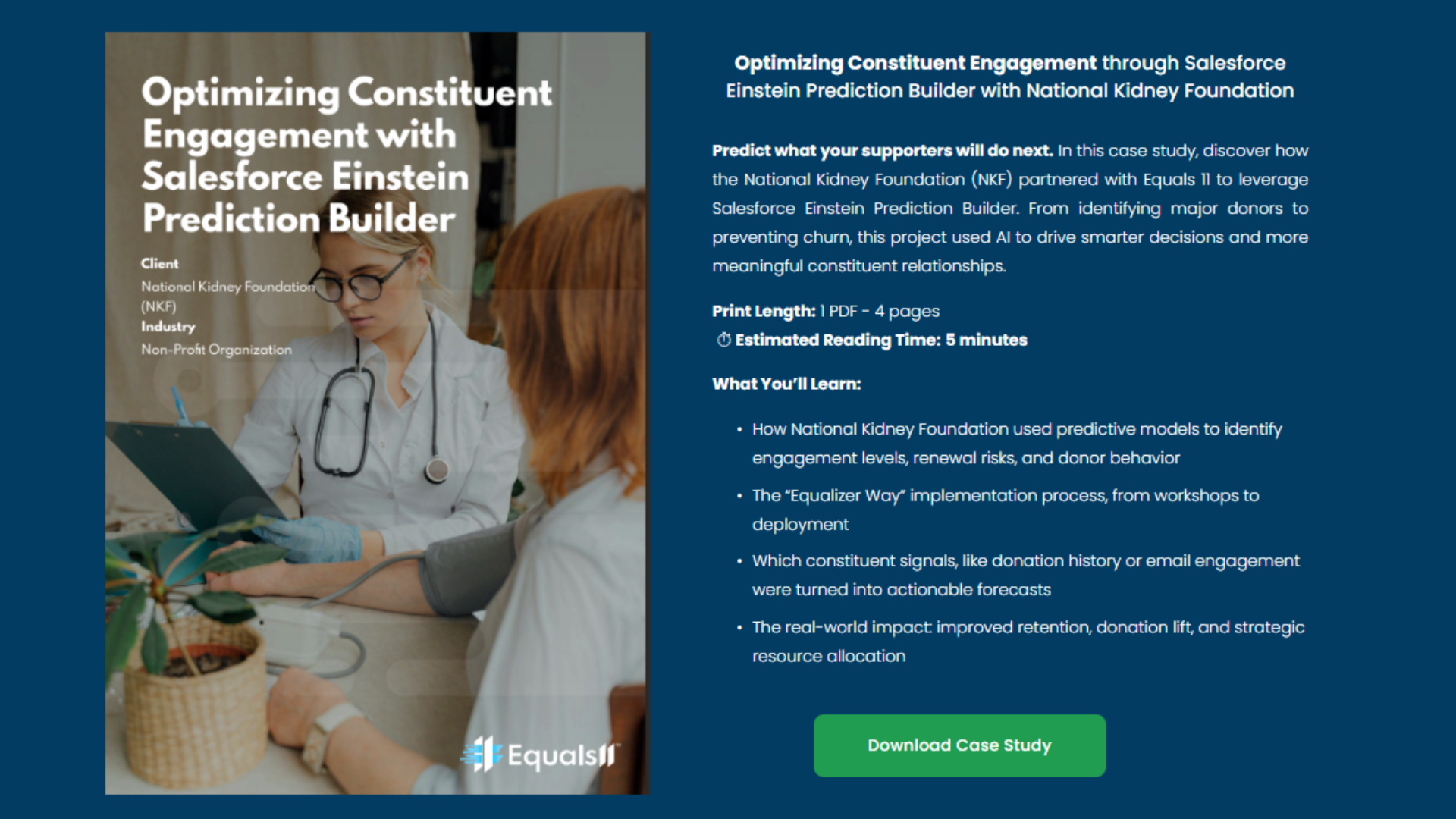
What this looked like at the National Kidney Foundation
That is the work Equals11 does with nonprofit teams. The National Kidney Foundation came to us with nearly a thousand employees and years of constituent data already in Salesforce, and a system that stored everything and surfaced nothing. Their VP of IT wanted Salesforce to stop being a data repository and start being a CRM. We did not move them to a new platform to get there. We worked on what the data could support, then implemented Einstein Prediction Builder and layered in Next Best Action so field teams opened a record and saw a concrete, prioritized next step instead of a history lesson.
Nick Duquette, their VP of IT, said Equals11 is very communicative, constantly soliciting feedback to course correct if need be.
The reason it belongs in a conversation about moving platforms is the order of the work. The platform question came second. What determined whether the new capability was worth anything was whether the underlying data could carry it, and that is true of an NPSP org, a Nonprofit Cloud org, and every AI feature Salesforce ships next year.
How to tell if this is the year to move
Move when there is a forcing event already on the calendar. You are replacing the fundraising platform or the payment processor anyway. A funder or your executive team is asking for outcome reporting that spans programs and services, which NPSP was never designed to carry. AI is on the roadmap, and the agent tooling is being built on the native model. Or you are carrying enough custom code on top of NPSP that maintenance is already expensive, in which case you are paying migration-sized money to stand still.
Stay where you are when NPSP does what your team needs, your data is in reasonable shape, no funder is asking for something the current structure cannot produce, and there is no budget this year for a project of this size. Staying is a legitimate answer. It stops being legitimate when it is a default rather than a decision. The difference is whether your board can see that someone weighed it, wrote down why, and set a date to look again.
What to do in the next quarter either way
Start with an inventory. Build the list of every automation, rollup, report, dashboard, and integration that touches an NPSP object, and name who depends on each one. You will find reports nobody has opened in a year and an integration nobody remembers commissioning. That list is the scope of any future migration, and it is also the fastest way to find work you can retire right now.
Then define your terms. Agree on what counts as a household, when a donor is considered active, and at what point a pledge becomes a gift. Those definitions either travel with you deliberately or get rewritten by accident during a migration, and the second version is the one that shows up wrong in a board report six months later.
Then clean. Duplicate constituents, empty fields, and records nobody ever defined are cheaper to fix in the system you know than in the one you are still learning.
None of that is migration work. It is the work that decides whether a migration takes six weeks or nine months, and every hour of it pays off if you stay on NPSP. What it needs is an owner and a date. A readiness assessment that lives in a slide deck and never becomes a scoped plan costs your organization the same year that drifting does, and it costs more, because you already paid for the assessment.
Salesforce is not expensive. Misalignment is.
Frequently asked questions
Is Salesforce NPSP being discontinued?
No. NPSP remains fully supported, and Salesforce has not announced an end-of-life or end-of-sale date for organizations already using it. What ended was feature development, which stopped in March 2023. Your org will keep running. It will not keep gaining new capability.
What is the difference between NPSP and Nonprofit Cloud?
NPSP is a managed package layered on top of standard Salesforce. Nonprofit Cloud is built natively into the core platform on the same shared data model Salesforce now uses across every industry. The practical difference is where new features land. They are built for the native platform first, and reaching a package layer takes additional work that Salesforce is no longer doing.
Can new nonprofits still get NPSP through Power of Us?
Not since December 2025. Eligible nonprofits still receive their ten donated licenses, but new applicants are directed to Agentforce Nonprofit rather than NPSP.
How long does an NPSP to Nonprofit Cloud migration take?
It depends almost entirely on how much sits on top of your NPSP objects and how clean your constituent data is. An organization with tidy data and a short list of reports and integrations can move in weeks. An organization with years of undocumented automation and duplicate constituent records should plan for months, and should spend the first stretch on inventory and cleanup rather than on migration itself.
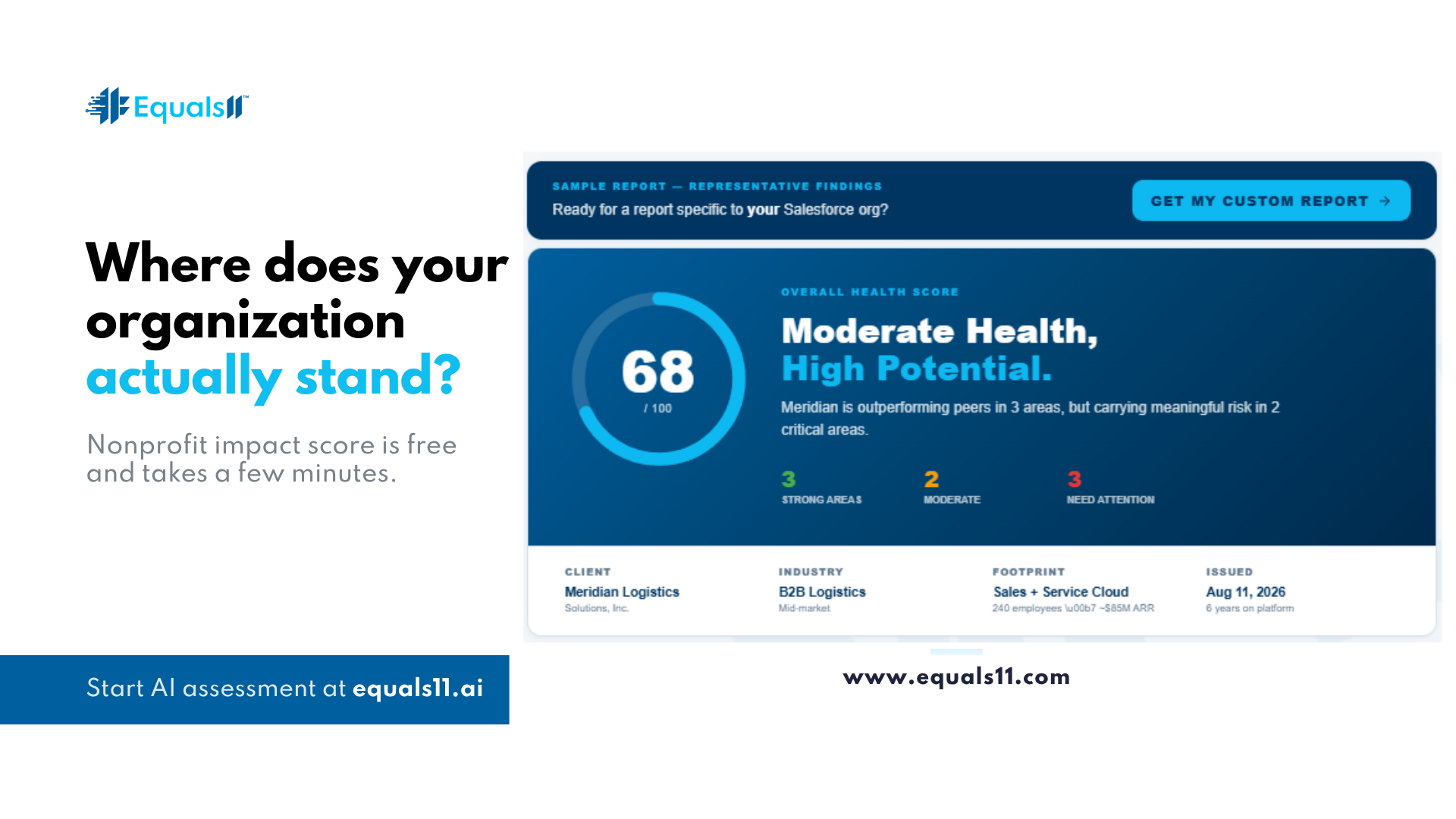
If you are not sure where your org stands, the Nonprofit Impact Score is free and takes a few minutes. It gives you a read on your data, reporting, and program tracking before you commit budget to anything. Take it at equals11.ai.
