Claudeforce: What Salesforce's Anthropic partnership changes
Salesforce and Anthropic announced Claudeforce on August 26. The coverage has focused on the size of the deal and the two CEOs on the same stage. For a company that already runs Salesforce and already questions the renewal line every year, the useful question is smaller and more urgent. A reasoning model can now read your org, work across it, and take action inside it. What is it going to find?
What was actually announced
Claudeforce launches with Salesforce in Claude, a plugin carrying 37 prebuilt sales skills covering work like meeting prep, deal health review, and pipeline review. It runs on AIforce, which Salesforce describes as an enterprise harness that exposes business data, workflows, and rules to any agent through MCP servers, APIs, and CLI tools. The onboarding experience reads a seller's context across Salesforce, Slack, and other connected systems, then builds a dashboard of their accounts and live pipeline.
The integration runs both directions. Claude sits inside Agentforce as a reasoning model for the Atlas Reasoning Engine, powers Agentforce Vibes and Agentforce Coworker by default, and is available in Agent Builder. Through Amazon Bedrock, it operates inside the Salesforce Trust Boundary, which is the part that matters for healthcare, financial services, and anyone else with a compliance officer who reads architecture diagrams.
Slack is the third leg. Claude is now the default model across Slack, powering Slackbot, Claude Tag, and Slack Code.
Salesforce in Claude is with select pilot customers now, with open beta expected in September 2026. Additional skills arrive later in the year.
The shift underneath the announcement
Benioff's framing was that "the UI is the AI." Strip the stagecraft, and there is a real architectural claim in it. For thirty years, enterprise software meant a person clicking through screens to reach data. The harness model inverts that. The data, the workflows, and the business logic become services that an agent calls directly, and the interface gets generated around the question being asked.
That has a consequence for anyone who owns a Salesforce org. The screen has been doing quiet work for years. Page layouts hid fields nobody should edit. List views scoped what people saw in practice. Reports were built by someone who knew which records to filter out. None of that logic lived in the data model. It lived in the presentation layer, and it held because humans only ever arrived through the front door.
An agent does not use the front door. It queries what the permission model allows and reasons over what the data model contains. Every shortcut that survived because it was hidden behind a layout is now exposed to something that reads everything at once.
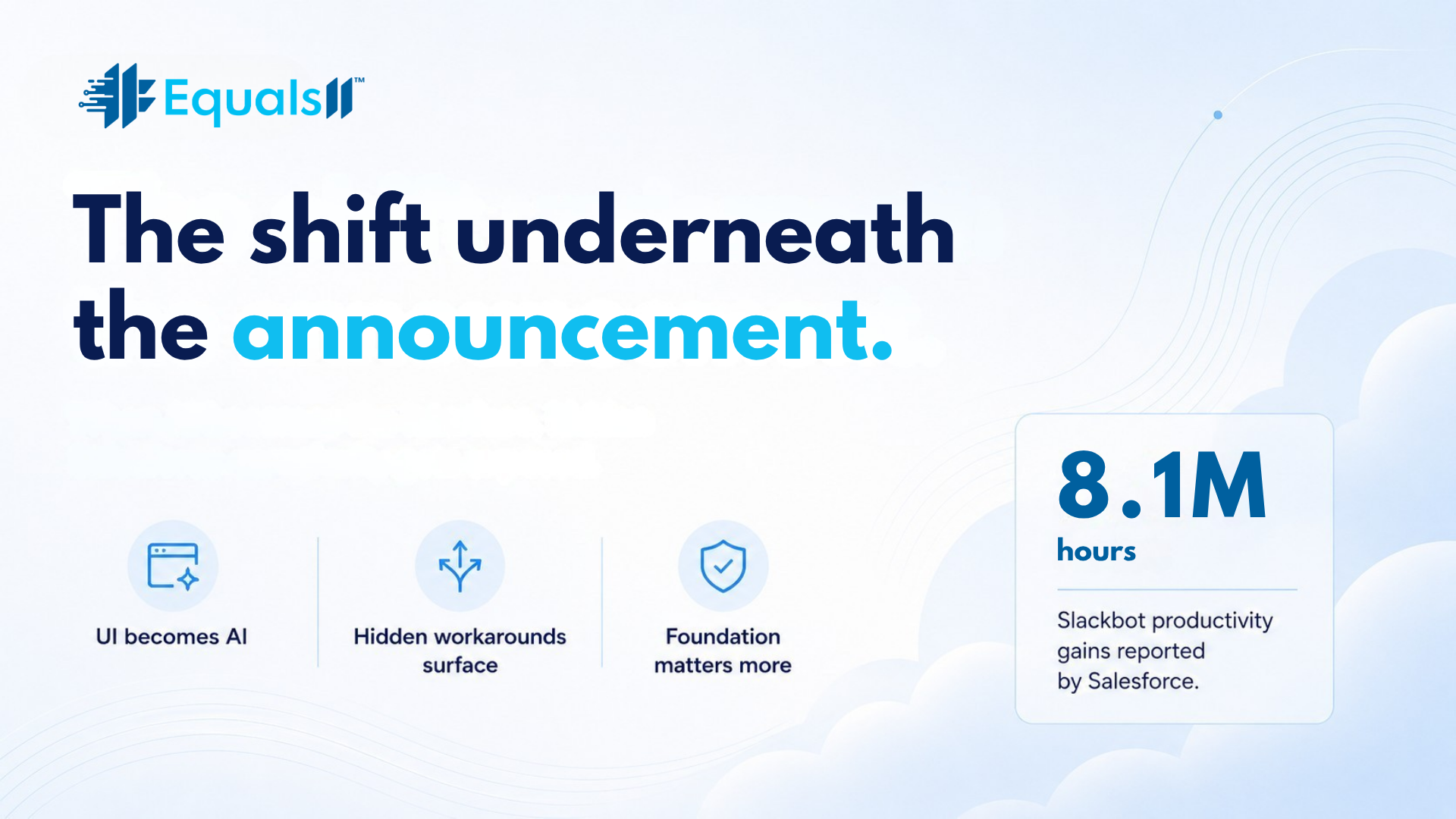
The second signal is consolidation. Salesforce and Anthropic are now customers of each other. Salesforce is Anthropic's preferred CRM, and Claude is the default model across Slack and inside Salesforce's own engineering organization. Salesforce reports Slackbot has driven 8.1 million hours of annualized productivity gains internally, more than double the prior quarter. Companies do not wire their own operations to a partner's model unless they intend the integration to be permanent. Plan accordingly.
Your business rules are now the guardrail.
One line in the announcement carries more operational weight than the rest. Salesforce says actions route through Salesforce so business rules are enforced when an action is taken.
Read that slowly. Your validation rules, required fields, sharing model, and approval processes are the entire safety layer between a reasoning model and your production records. As a design decision, it is sound. As an assumption about your org, it deserves a check.
Validation rules get deactivated for a data load and never switched back on. Required fields get enforced on the page layout and nowhere else, which leaves the API path open. Approval processes get replaced by a note to a manager and a manual stage change that everybody agreed to years ago. None of this caused much damage while a person sat between the intent and the record. It behaves differently when an agent updates 40 opportunities in one pass because the rule that should have blocked it was turned off in 2023.
The cost is not an inaccurate dashboard. It is records changed at speed and the consulting hours to find them all afterward.
One admin connection, every seller on day one
The setup model removes friction on purpose. An admin connects Salesforce in Claude once, authentication and permissions are managed centrally, and every seller gets access immediately. No per-user setup. No account-by-account re-audit.
That is good design when the permission model is accurate. In an org that has been live five years or more, it rarely is. Profiles carry access granted for a project that ended two reorgs ago. Permission sets get assigned to solve a Tuesday problem and never removed. Someone in finance can still read the full opportunity object because a report needed it once in 2022.
Right now that surplus access is theoretical, because nobody in finance opens the opportunity object. Give an AI the same access and ask it a broad question, and the surplus stops being theoretical.
Access review is cheap on a schedule. It is expensive after an incident, on a deadline, with legal in the room.
Reasoning does not repair a fragmented data model.
Deal health review needs opportunity stages that mean the same thing in every region. Pipeline review needs amount and close date entered against one definition instead of five. If ERP data reaches Salesforce because a manager retypes it every Thursday, Claude reasons over what got typed. Not over what is true in the ERP.
AI on broken data is just expensive broken data. That held for Einstein, it held for Agentforce, and a stronger reasoning model does not change the arithmetic. What changes is the confidence of the output and the speed at which people act on it. A bad number from a spreadsheet gets challenged in the meeting. A bad number attributed to an AI reading your live CRM gets believed.
What to do before open beta
Work backward from the revenue motion. Identify the objects and fields those 37 skills would touch, which for most orgs means account, contact, opportunity, and whatever custom objects carry the real pipeline. That is a short list, and it is the only list that matters this quarter.
Then run three checks against it. Confirm which validation rules and required-field enforcements are actually active, at the object level rather than the layout level. Pull the full list of profiles and permission sets with read or edit access to those objects and justify each one out loud. Confirm that stage definitions, amount fields, and close date conventions are consistent across every region and business unit feeding the pipeline.
None of that is exotic work. It is the governance work that gets deferred every quarter because nothing visibly breaks when you skip it. The deadline changed. Salesforce set it, not you.
The organizations that get value out of Claudeforce in the first year will be the ones whose data model and permission structure could already survive an audit. The rest will spend that year discovering what their page layouts were hiding.
Salesforce is not expensive. Misalignment is.
Equals11 designs the AI and CRM strategy, remediates the technical debt underneath it, and executes with the same engineering team. One accountable partner from the boardroom to the codebase.
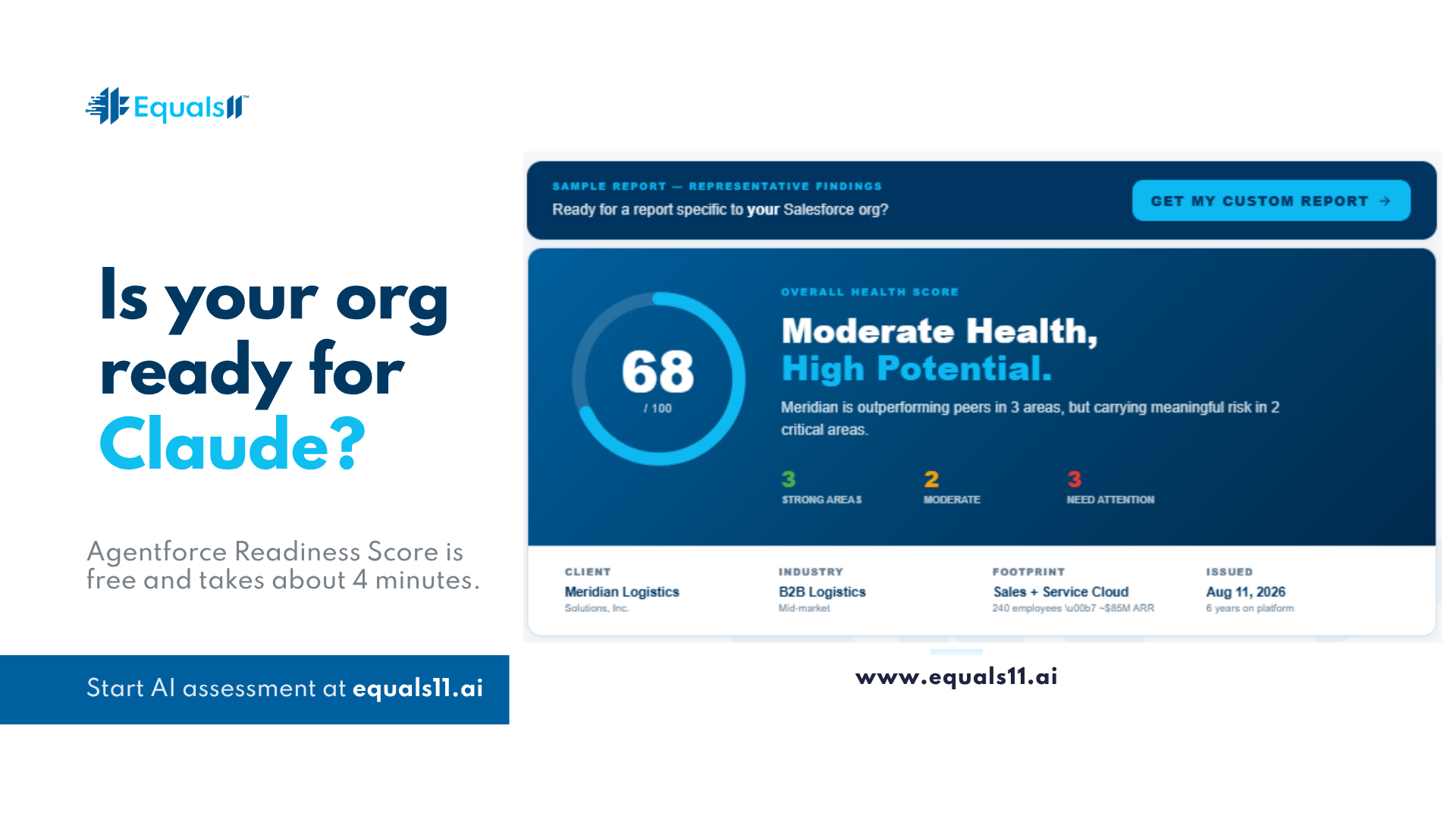
Find out where your org actually stands before open beta opens. Free. Take the Agentforce Readiness Score at equals11.ai.
Frequently asked questions
What is Claudeforce?
Claudeforce is the expanded partnership between Salesforce and Anthropic announced on August 26, 2026. It brings Claude's reasoning together with Salesforce data, workflows, business logic, and governance. The first release is Salesforce in Claude, a plugin with 37 prebuilt sales skills, plus Claude running inside Agentforce and as the default model across Slack.
When will Salesforce in Claude be available?
Salesforce in Claude is with select pilot customers now, and Salesforce expects open beta in September 2026. More prebuilt skills are scheduled to arrive later in 2026. Availability may vary by region and is governed by customer agreements, so confirm timing with your account team rather than planning against the announcement date alone.
Do I need to clean up Salesforce before using Claude with it?
Yes, and specifically the data model and the permission model. Salesforce in Claude routes actions through Salesforce so business rules are enforced, which makes your validation rules, required fields, and sharing model the entire safety layer. Inconsistent stage definitions and inherited profile access both produce confident, wrong output at speed.
Is Claudeforce safe for regulated industries?
Claude is available within the Salesforce Trust Boundary through Amazon Bedrock, which lets regulated customers deploy AI while keeping data and workloads inside that boundary. That covers infrastructure. It does not cover your internal access control, field-level security, or audit trail, which remain your responsibility and are usually where compliance findings actually originate.
How is this different from Agentforce?
Agentforce is Salesforce's agent platform, and Claude now serves as a reasoning model inside it. Salesforce in Claude runs the other direction, putting Salesforce data and governed actions inside the Claude interface where sellers already work. Both depend on the same foundation. Clean data, consistent definitions, and a permission model that reflects current reality.