
Salesforce Admin Salary Guide 2026: Key Trends and Analysis
The 2026 Salesforce Salary Survey is out, and the numbers tell an interesting story. Salesforce Admin salaries are flattening. The job market is tougher. And the expectations placed on admins are expanding well beyond traditional admin work.
For businesses trying to get real value from Salesforce, this raises a question worth asking: is hiring a full-time admin still the best way to support your org?
For many mid-market companies, the answer is no. Not because admins are not valuable, but because the Salesforce ecosystem has become too broad for any single hire to cover. A managed services model can deliver more expertise, more flexibility, and better outcomes, often at a comparable or lower cost.
Here is what the data is telling us, and what it means for how you staff your Salesforce environment.
Admin salaries are rising, but so are the expectations
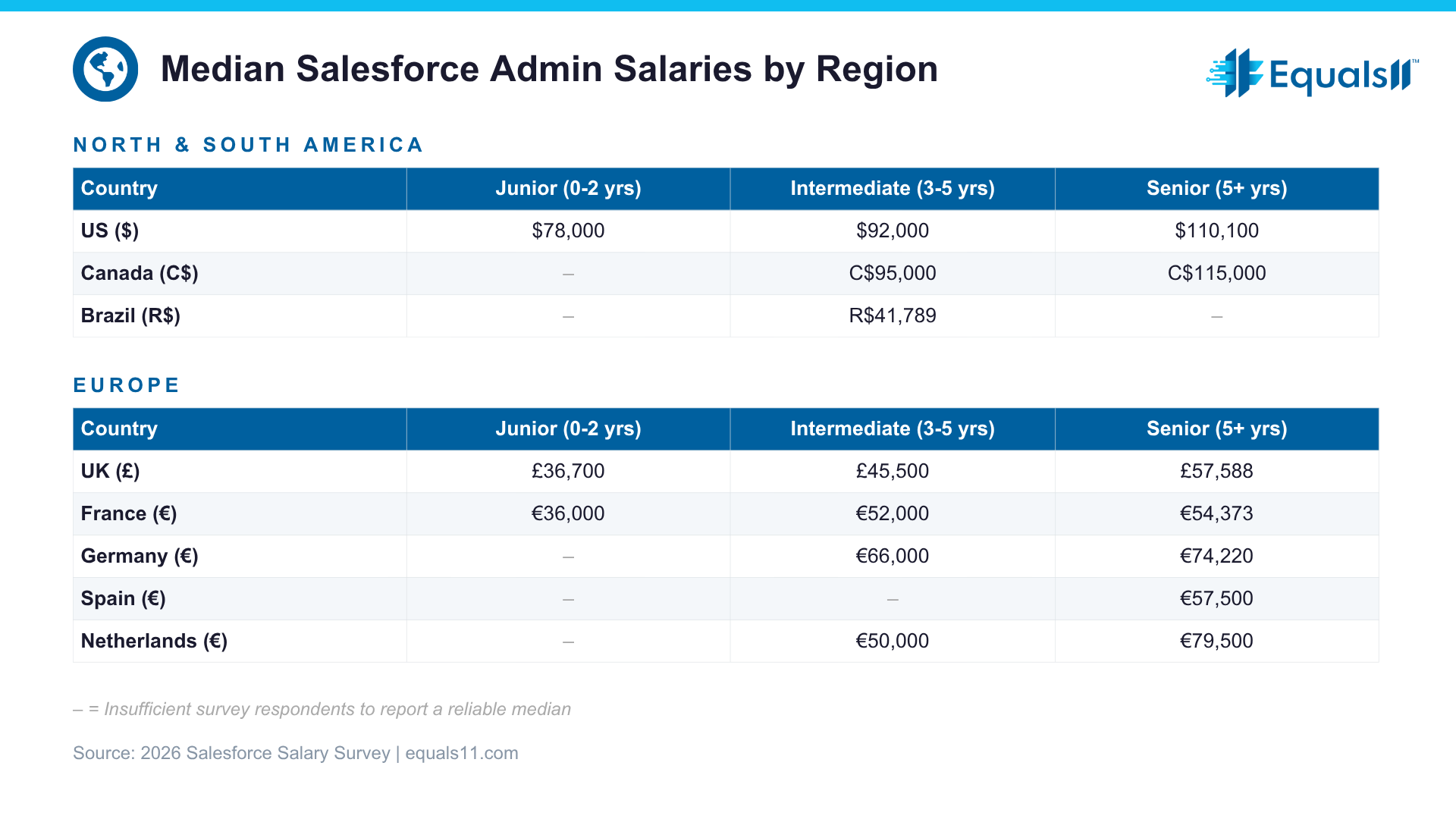
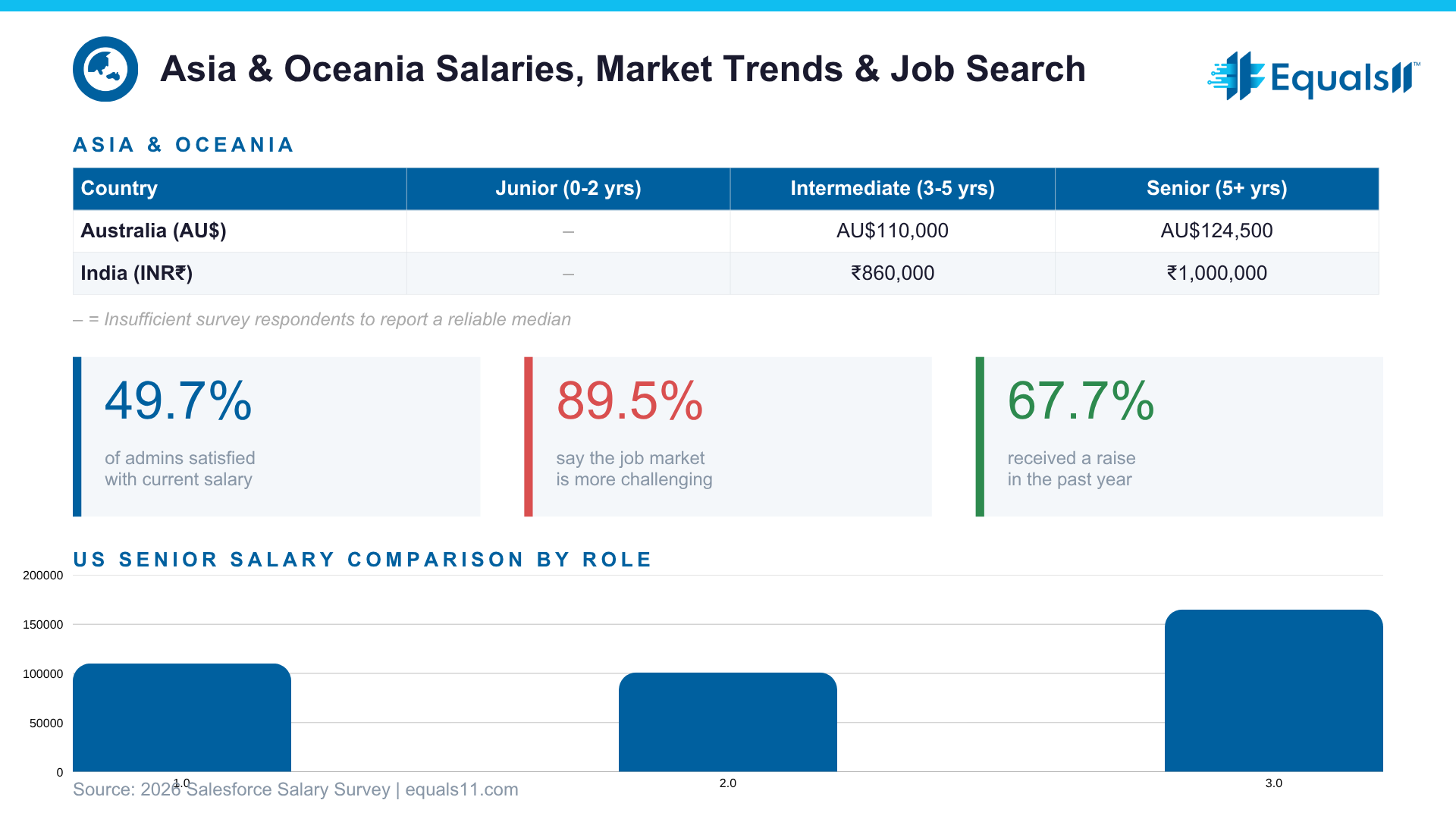
According to the latest salary survey, a senior Salesforce Admin in the US now earns a median salary of $110,100. In Australia, that figure is AU$124,500. In the UK, senior admins report a median of £57,588.
Those are not small numbers, and they do not include benefits, bonuses, recruiting costs, or the time it takes to find the right person. The survey found that the most common timeframe for admins to find a new role is three to six months. For the company doing the hiring, the timeline is similar. That is months of open headcount, interviews, and onboarding before you see results.
At the same time, what companies expect from admins has shifted. Organizations now want professionals who combine admin skills with business analysis, automation, data strategy, security architecture, and AI awareness. The traditional admin who manages users and page layouts is no longer enough.
That is a lot to ask of a single person. And it raises the question of whether a single hire can realistically cover all of it.
The skills gap is real, and getting wider
Salesforce releases three major updates a year. The platform now spans Sales Cloud, Service Cloud, Data Cloud, Marketing Cloud, CPQ, Financial Services Cloud, Agentforce, MuleSoft, and more. Each of these areas has its own learning curve, its own certifications, and its own set of best practices.
The salary survey data reflects this complexity. Specialists in niche areas like CPQ, Data Cloud, and Financial Services Cloud command higher salaries because fewer people have those skills. Meanwhile, 12.3% of admins hold no certifications at all, and the largest group (55.2%) holds between one and three.
This is not a criticism of admins. It is a structural problem. Salesforce has grown into a sprawling ecosystem, and no single person can be expected to master all of it. When your org needs help with Flow automation on Monday, a MuleSoft integration on Wednesday, and a Data Cloud configuration on Friday, a generalist admin is going to struggle. Not because they lack ability, but because the breadth of what is being asked simply exceeds what one role can cover.
What you actually pay for a full-time admin
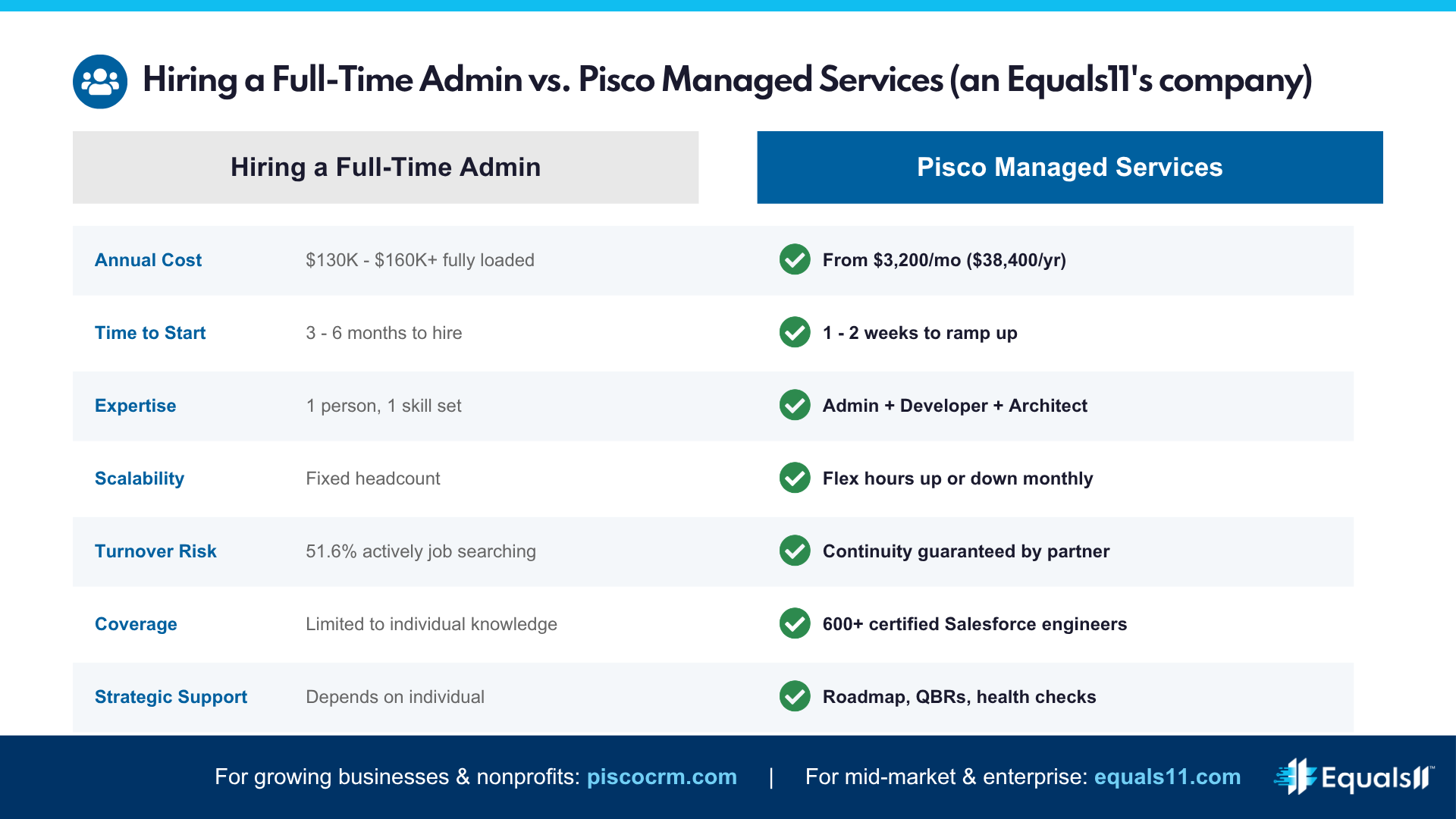
Salary is just the starting point. When you hire a full-time Salesforce Admin in the US, you are typically looking at $92,000 to $110,000 in base salary at the intermediate to senior level. Add benefits, taxes, recruiting fees, and onboarding time, and the fully loaded cost often lands between $130,000 and $160,000 per year.
And that gets you one person with one set of skills.
If that person leaves (and the survey shows that over half of admins have been job searching in the past 18 months), you are back to square one. The institutional knowledge walks out the door, the hiring cycle restarts, and your Salesforce org sits without dedicated support in the meantime.
The survey also found that 89.5% of respondents say the job market feels more challenging than in previous years. This cuts both ways. Companies are finding it harder to attract the right talent, and admins are finding it harder to land roles that match their expectations. The result is a mismatch that leaves both sides frustrated.
The managed services alternative
A managed services model flips the equation. Instead of hiring one person and hoping they can cover everything, you get a team. Instead of carrying a fixed headcount cost whether you need the capacity or not, you get flexibility. Instead of relying on one individual’s knowledge, you tap into a much wider bench of expertise.
Here is how that works in practice. When your org needs admin work, you get an admin. When it needs a developer, you get a developer. When it needs an architect for a complex integration, you get an architect. You are not paying for all of those roles full-time. You are accessing them as the work demands.
This model is particularly relevant given the survey’s findings about specialization. The data shows that specialists in areas like CPQ, Data Cloud, and Financial Services Cloud earn significantly more because their skills are scarce. With managed services, you get access to those specialists without hiring each one individually.
There is also the continuity factor. Turnover does not reset your progress. Documentation, roadmaps, and institutional knowledge live with the partner, not with a single employee. If one team member transitions, the partner handles the replacement and knowledge transfer without disrupting your business.
Remote work, location, and hidden trade-offs
The survey surfaced another detail worth considering. Fully remote Salesforce professionals were more than twice as likely to report a salary decrease compared to those working in the office. Hybrid workers fell somewhere in between.
For companies, this creates a tension. If you want to attract top admin talent, you may need to offer competitive in-office or hybrid compensation. If you want to reduce costs by hiring remote, you may end up with candidates who are also accepting a pay cut, which can affect the quality of the applicant pool.
A managed services partner sidesteps this dynamic entirely. The partner handles sourcing, compensating, and retaining the talent. You pay for outcomes and deliverables, not for managing the complexities of individual employment arrangements.
This does not mean you should never hire an admin
There are situations where an in-house admin makes perfect sense. If your Salesforce environment is stable, well-documented, and does not require frequent changes or complex integrations, a strong admin can handle the day-to-day work well.
But for many growing companies, the reality is different. The org is evolving. New clouds are being added. Technical debt is piling up. And the list of things the business needs from Salesforce keeps getting longer.
In those cases, the smartest approach is often a hybrid one: a capable internal admin who owns the day-to-day, paired with a managed services partner who provides the depth and breadth of expertise that no single hire can replicate.
What Equals11 brings to the table
At Equals11, we work with mid-market businesses that are dealing with exactly these challenges: backlog pressure, capacity gaps, and Salesforce environments that have outgrown the team supporting them.
When you partner with us, you are not hiring one person. You are accessing a global talent pool of over 600 certified Salesforce engineers, including administrators, developers, architects, and consultants. Our managed services packages start at 40 hours per month and scale up based on what your business needs. Each engagement includes a dedicated Client Success Manager, a Salesforce Administrator, and access to developers and solution architects as the work requires.
We handle roadmap strategy, backlog execution, quarterly business reviews, and ongoing optimization. If you need to scale up for a major project or scale back during a quieter period, the team flexes with you. Our typical ramp-up time is one to two weeks, not the three to six months the salary survey reports as the average hiring timeline.
We also focus on culture fit and communication, not just technical ability. Our teams span offices in Europe, Latin America, and the United States, which allows us to match the right people to each client based on time zone, working style, and industry context.
The salary survey data makes a clear case: the cost of supporting Salesforce internally is going up, and the expectations are getting harder to meet with a single hire. Managed services offer a different path, one that gives you broader expertise, faster access to talent, and more predictable costs.For small businesses and nonprofits looking for the same level of expertise at a leaner price point, Pisco offers Continuum Hypercare managed services starting at $3,200 per month. You’ll get the same 600+ certified engineer talent pool, the same delivery standards, and the same strategic approach, just sized for smaller teams and faster timelines.
If your Salesforce org has outgrown your current team, or if you are weighing the cost of your next admin hire against what a partner could deliver, we would love to talk.
Visit equals11.com/contact to schedule a conversation.
About Equals11
Equals11 is an award-winning Salesforce consulting partner recognized by Clutch for 4 consecutive years and across 8 categories in 2026. We help growing businesses and nonprofits implement, optimize, and get real value from Salesforce, with 100% five-star reviews on the Salesforce AppExchange.
