
The 2026 Data Cloud Guide for Mid-Market Salesforce Orgs
Your Salesforce org is ready for Agentforce. The data underneath it is not. That is the gap killing AI rollouts inside mid-market companies right now.
Agentforce agents need a unified customer profile to ground their responses. Data Cloud is what builds that profile. Skip the prep work, and you get agents that hallucinate, stall, or quietly burn through credits while delivering nothing. Salesforce reported Data Cloud and Agentforce combined ARR tripled year over year to $2.9B entering FY26. Partners are reporting Data Cloud as the number one prerequisite for any enterprise-scale agent deployment.
This guide walks through how to layer Data Cloud onto your existing Salesforce environment without a full re-implementation. No greenfield. No reset. Use what you already own.
Why Data Cloud became mandatory
Spring '26 release notes tied Einstein Conversation Insights native storage and Agentforce grounding directly to Data Cloud. That changed Data Cloud from a nice-to-have into a prerequisite.
The community has caught up. Threads on r/salesforce and the Trailblazer forums show the same pattern. Buyers want Agentforce. They learn that Data Cloud is the gating dependency. Then they hit a $40K to $80K data cleanup bill and a three to six-month timeline before the first agent can launch. Some stall. Some abandon the project. The ones who succeed plan for it from the start.
The shift is simple. Data is now the biggest issue for agent hydration in non-greenfield orgs. If your customer data is scattered across Salesforce objects, external systems, spreadsheets, and shadow tools, no agent will perform reliably on top of it.
The five-step adoption framework
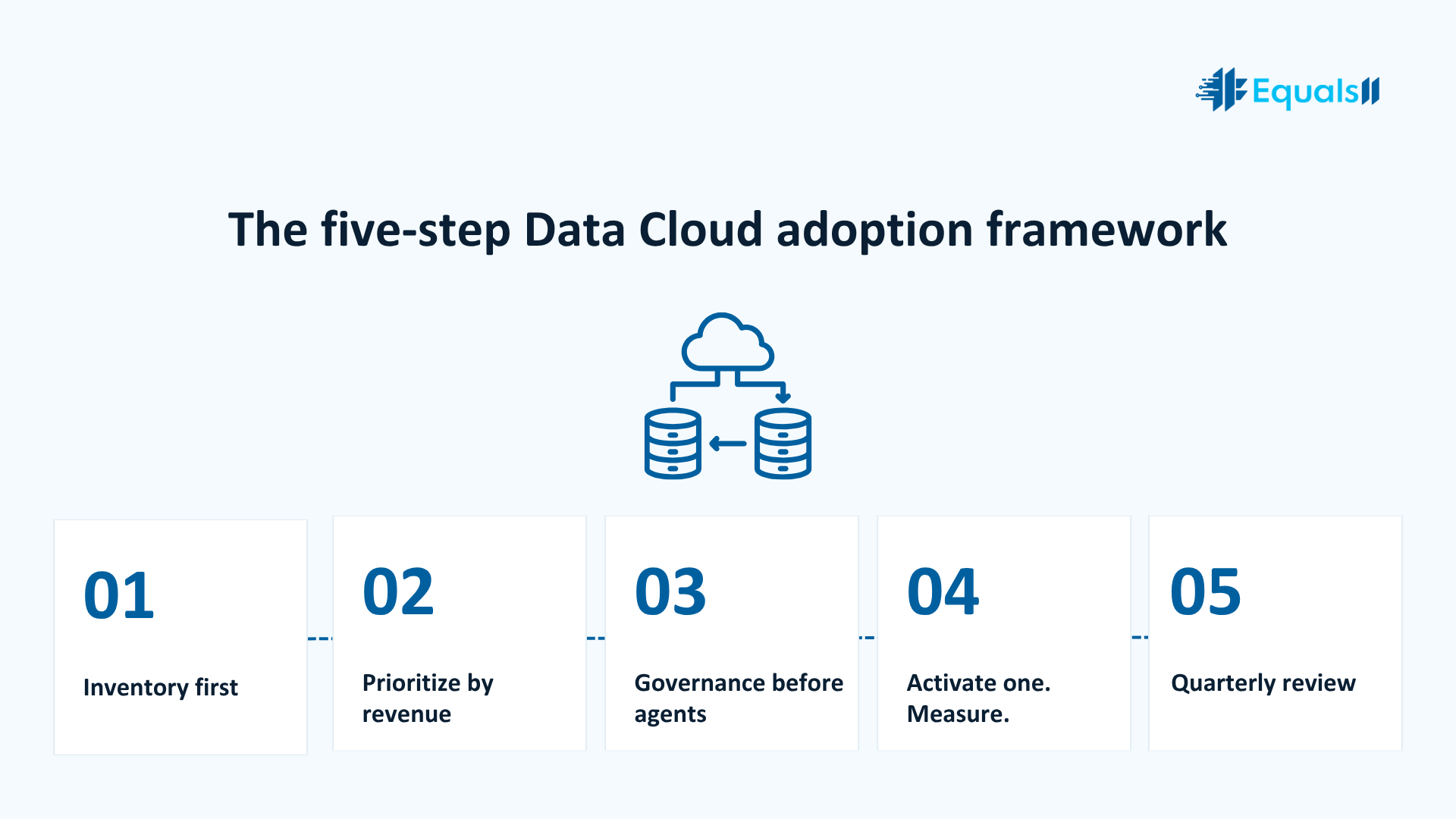
This is the sequence Equals11 uses inside mature orgs. Each step builds on the last. Skip a step and the next one breaks.
Step 1. Run a data inventory before you buy a single Data Cloud credit
Map every source where customer data lives today. Salesforce objects, marketing automation, billing systems, support platforms, data warehouses, and the spreadsheets your reps still keep on their desktops.
For each source, document four things. What lives there? Who owns it? How fresh it is. What it connects to. This becomes the foundation for every Data Cloud decision you make later.
The teams that skip this step end up paying twice. Once to ingest bad data into the Data Cloud. Then again, to clean it up after the agents start failing.
Step 2. Prioritize unification by revenue motion, not by data volume
Most teams try to unify everything at once. That is how Data Cloud bills get out of control.
Pick the two or three customer journeys that drive the most revenue. Quote-to-cash. Renewal. Support escalation. Build your unified profile around those first. Leave the rest for phase two.
This approach delivers a working Agentforce use case in eight to twelve weeks. The boil-the-ocean approach delivers nothing in six months, and a finance team asking hard questions about the spend.
Step 3. Build the governance layer before activation
Data Cloud without governance is a faster way to do the wrong thing.
You need three things in place before any agent goes live. A data dictionary that defines every unified field. A clear policy on which systems are sources of truth. A consent and access framework that controls what the agent can see and act on.
Governance is the part most teams want to skip. It is also the part that prevents the lawsuit, the data leak, and the agent who emails a customer with another customer’s information.
Step 4. Activate one use case. Measure. Then expand.
The mistake here is launching three agents at once because the demo looked easy.
Pick one. A lead qualification agent. A renewal risk agent. A support deflection agent. Launch it for a defined user group. Measure adoption, accuracy, and revenue impact for at least 30 days.
If the numbers work, expand the user base before you launch a second agent. If the numbers do not work, fix the data underneath before you blame the model.
Step 5. Set a quarterly architecture review
Data Cloud is not a project. It is a layer in your architecture that needs care.
Review the unified profile every quarter. New systems get added. Old sources get retired. Customer data changes shape. Without a review cadence, you drift back to the fragmented state that Data Cloud was supposed to fix.
What this saves you
A mid-market org running this framework typically launches its first production Agentforce use case in eight to twelve weeks. The teams that skip the prep work take nine to fourteen months and often miss their target use case entirely.
Data Cloud consumption stays predictable. License spend gets allocated against revenue outcomes. Agents perform because the data underneath them is clean and unified.
The framework also reuses your existing Salesforce architecture. No rebuild. No migration. No second implementation invoice.
Where to start this week
Pull a list of every system that holds customer data inside your company. Mark, which ones connect to Salesforce today, and which ones do not? Rank them by how often your sales, service, or marketing teams reference them.
That single document tells you what your Data Cloud adoption is actually going to cost and how long it will take. It is the starting point for every decision that follows.
Get the full Data Cloud playbook
We wrote the deeper version of this framework as an ebook. From Silos to Insights: The Data-Driven Leader’s Guide to Salesforce Data Cloud covers the architecture decisions, the unification sequence, and the governance model in full detail. It is built for the leader who has to defend a Data Cloud budget to a CFO and a rollout plan to a CRO in the same week.
Download it here: equals11.com/ebook-salesforce-data-cloud
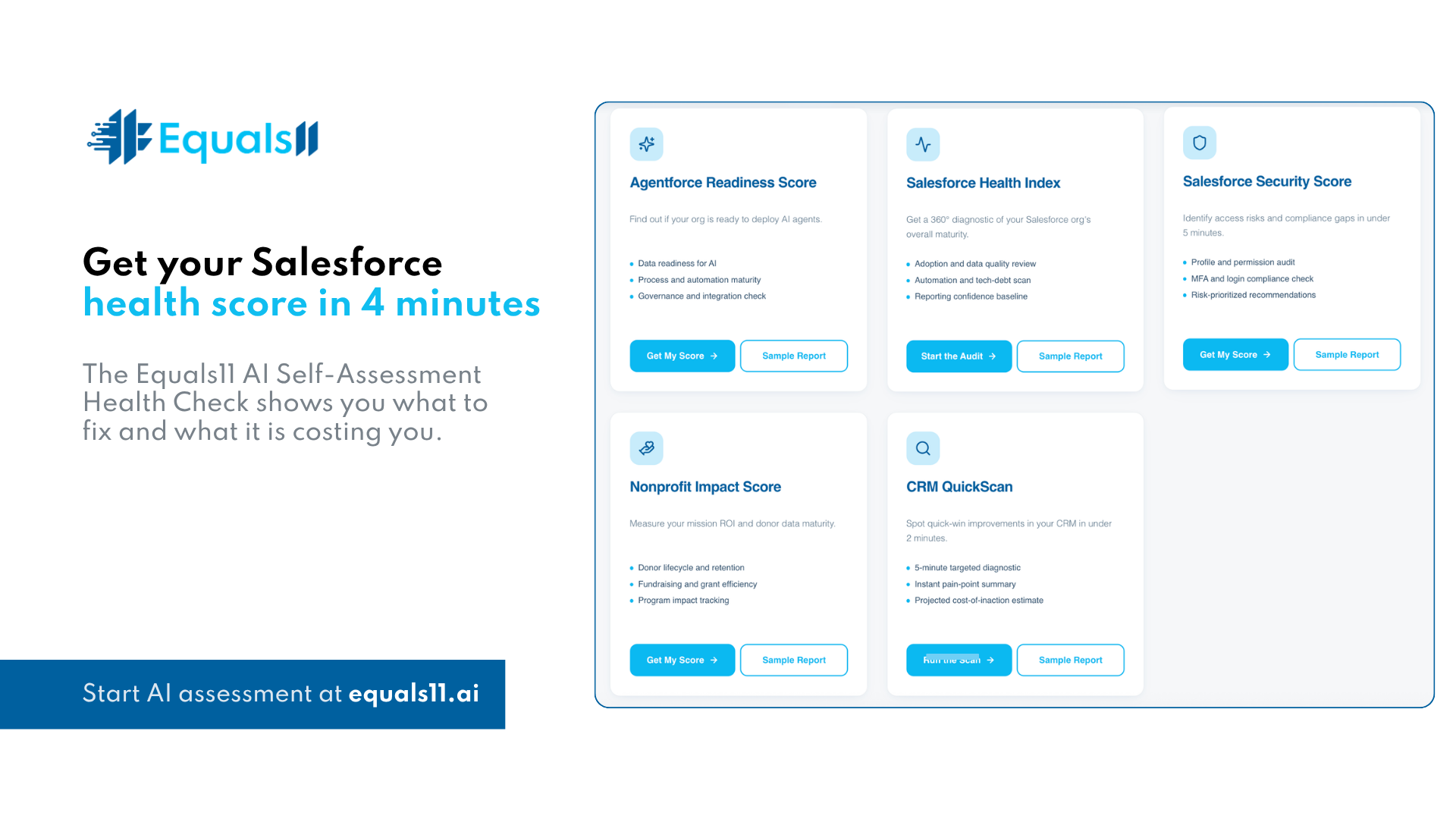
Not sure if your org is ready for Agentforce yet? Run the free AI Self-Assessment at equals11.ai. It scores your readiness across data, governance, and architecture in a few minutes.
Salesforce is not expensive. Misalignment is. Data Cloud is where that misalignment becomes visible.
