
How to prove Salesforce ROI to your CFO without lying with numbers
The question lands in your inbox sometime in Q3. The CFO has been reviewing the renewal forecast. Salesforce is up for renewal next year. The bill is north of $400K when you add licenses, integrations, and the AppExchange stack. And somewhere in the executive Slack, someone asked the question every RevOps leader, IT director, and Salesforce owner dreads.
"Are we actually getting value from Salesforce?"
You know the answer is yes. The system runs the business. The reps live in it. Marketing routes leads through it. Service uses it for case management. Pull the plug, and the company stops. But that is not what the CFO is asking. The CFO is asking for a number. A defensible, board-ready number that proves the line item is worth what the company pays for it.
This is where most internal Salesforce owners go wrong. They send back adoption stats. Login counts. Dashboard usage. A bullet list of features the team activated last year. None of that is ROI. That is activity. The CFO already knows the team uses Salesforce. The question is whether the use produces a measurable financial return.
Here is how to answer the question properly. Without inflating numbers. Without hiding behind soft metrics. Without losing your renewal budget.
Why most Salesforce ROI calculations fail the CFO test
A CFO does not want a Nucleus Research stat about $8.71 returned for every $1 spent. Nice line for a marketing deck. Useless in a renewal conversation. The CFO wants three things. What did we spend? What did we get? How do you know?
Most internal ROI cases collapse on the second question. The team produces a total spend number. Licenses, partner fees, internal headcount. That part is clean. Then the "value" side gets fuzzy. Higher adoption. Better reporting. Improved visibility. None of these convert to dollars on a P&L.
The real problem sits deeper. Most teams never captured a baseline. They cannot tell you what the pipeline review process cost before Salesforce ran it. They cannot tell you the average time to close a deal three years ago versus today. They cannot tell you how many hours per week the sales team spent on manual reporting before dashboards existed. Without a baseline, every ROI claim is directional at best and fictional at worst. CFOs can smell the difference.
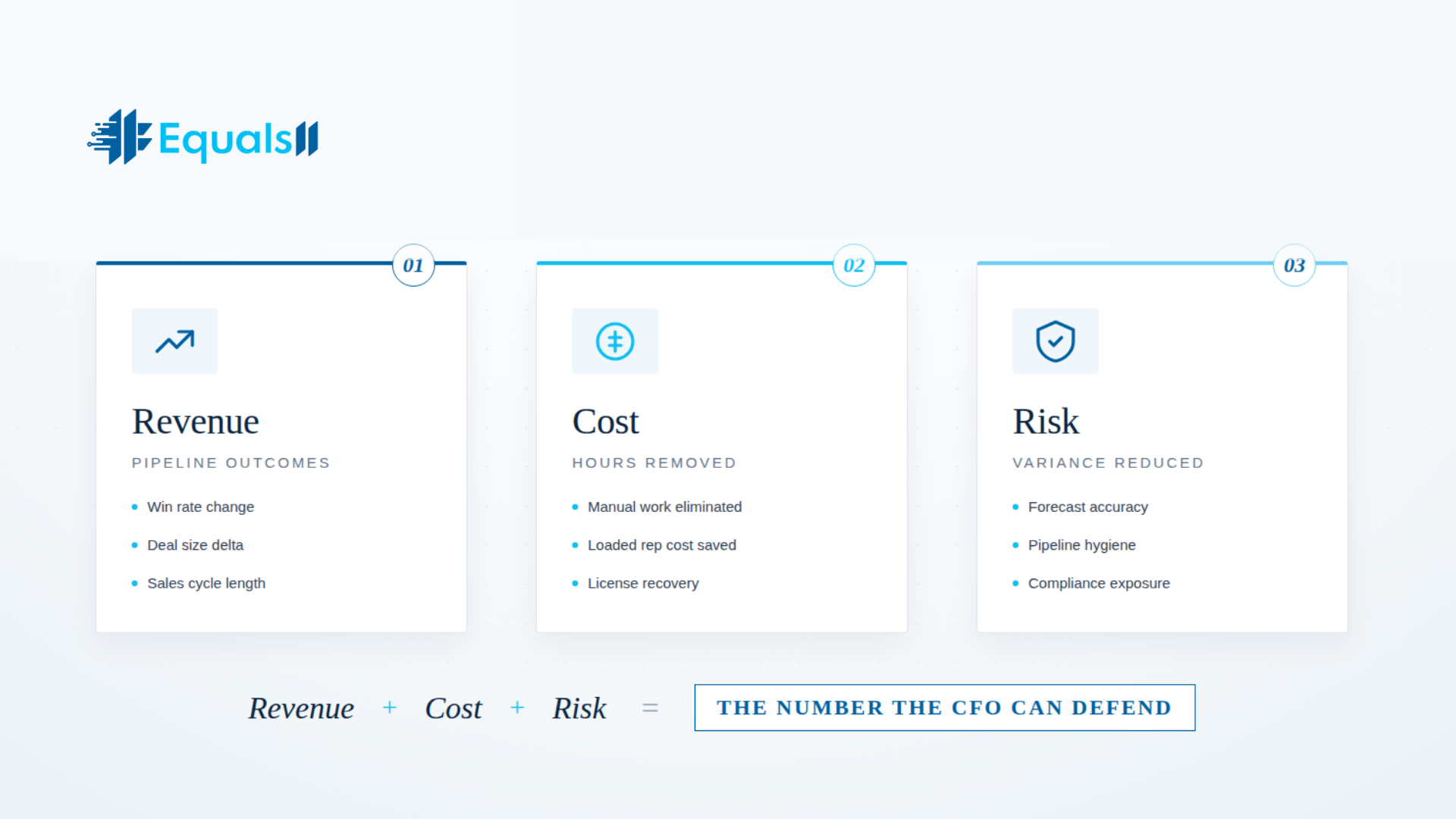
The fix is not a better dashboard. The fix is a structured approach to translating Salesforce activity into financial outcomes that the CFO already tracks. Revenue. Cost. Risk.
Translate Salesforce into the three numbers your CFO actually cares about
Your CFO does not run a forecast on the adoption rate. The forecast runs on revenue gains, cost savings, and risk reduction. Map your Salesforce ROI case to those three categories, and the conversation becomes simple.
Revenue gains. Track the win rate change since Salesforce was implemented or last optimized. Track average deal size. Track sales cycle length. Track lead-to-opportunity conversion. These are pipeline outcomes the CFO already models. If your average deal size went from $42K to $51K over 18 months and your sales cycle shortened by 11 days, that is a number you can defend. Multiply the delta by deal volume. That is the revenue lift.
Cost savings. Quantify hours removed from the workflow. A 50-person sales team that used to spend 4 hours a week on manual pipeline updates and now spends 1 hour a week recovered 150 hours per week. At a fully loaded rep cost of $120 per hour, that is $18,000 per week. $936,000 per year. The CFO will check your math. Make sure the baseline is real. Survey the team if you have to.
Risk reduction. Harder to quantify. Still real. Forecast accuracy is the cleanest version of this. If your forecast variance dropped from 22% to 7% after a data model redesign, the company can plan inventory, hiring, and capital deployment more precisely. Translate that into dollars saved or capital freed. Pipeline hygiene reduces deals lost to bad data. Governance reduces compliance exposure. Each of these has a number behind it if you are willing to do the work.
The framework is structured. Revenue, cost, risk. Three columns. Real numbers in each. That is the document the CFO can take to the board.
The baseline problem and how to fix it without rewriting history
You do not have a baseline. Most teams do not. Salesforce was implemented four years ago by a partner that no longer exists. Nobody captured pre-implementation pipeline metrics. The sales team has turned over twice since then. The reports from 2022 are gone.
This is fixable. Three options.
Option one. Build a synthetic baseline. Reconstruct what the metrics likely were before Salesforce, based on industry benchmarks for your size and segment. State the assumption clearly. The CFO will accept a documented assumption far more readily than a number with no source.
Option two. Use the last optimization as the baseline. If you cleaned up the data model 18 months ago, use the period before that as the baseline. Pull the reports from that window. Compare to today. The point is not to prove Salesforce as a platform delivered value. The point is to prove the latest investment delivered value.
Option three. Forward baseline. If neither of the above works, start measuring now and project forward. Lock in the current numbers. Make the next 12 months the proof window. This works best when paired with a specific optimization initiative that the CFO can attach the spend to.
Real CFOs do not expect perfect history. They expect rigor. A documented baseline with a stated methodology beats a precise number with no foundation every time.
Where the ROI case usually leaks
After a hundred orgs, the same five leaks show up.
Shadow CRM. Your team uses Salesforce officially. The actual pipeline lives in a Google Sheet, a Notion doc, and three rep-managed Excel files. If half the revenue motion happens outside the system, the system cannot get credit for it.
Duplicate records. Your dashboards say 8,400 accounts. The reality is 5,200. Your win rate, conversion rate, and deal velocity numbers are all inflated or deflated by the duplicate count. The CFO will ask. Be ready.
Manual data entry replacing automation. The org has 47 active flows. The team still updates fields manually because they do not trust what fires when. Time saved on paper. Time spent in practice. Net zero ROI.
Underused licenses. The company pays for Marketing Cloud, CPQ, or Sales Cloud Einstein. Half of those licenses are inactive. That is a recoverable cost the CFO can claim immediately.
Reports that nobody trusts. Pipeline says $4.2M. VP of Sales says $3M. Finance is modeling off a third number. If the executive team is arguing about which version of the data to believe, the system has not produced value. It has produced confusion.
Fix the leaks first. Then run the ROI math. The CFO will respect the work.
What to bring to the renewal conversation
A defensible ROI case for Salesforce fits on one page. Three columns. Revenue, cost, risk. A documented baseline with the methodology stated. The number you are claiming. The math behind it. A short list of leaks you identified and what you plan to do about them. A one-line ask. Renew, optimize, or replace.
The CFO does not need a 40-slide deck. The CFO needs proof that the investment is producing a return and that you are the person who knows where the value is hiding.
Salesforce is not expensive. Misalignment is expensive. If the system was designed three years ago for a company that no longer exists, the platform is not the problem. The fit is. Most renewal conversations should produce an optimization plan, not a replatform decision. The cost of replatforming a mid-market Salesforce org typically runs $500K to $2M and takes 12 to 18 months to recover. The cost of optimizing the existing org typically runs a fraction of that and pays back within 6 to 9 months.
If you cannot answer the CFO's question today, start with a baseline audit. Walk the system. Find the leaks. Document the methodology. Then have the renewal conversation. That is how Salesforce stops being a line item and starts being a growth engine.
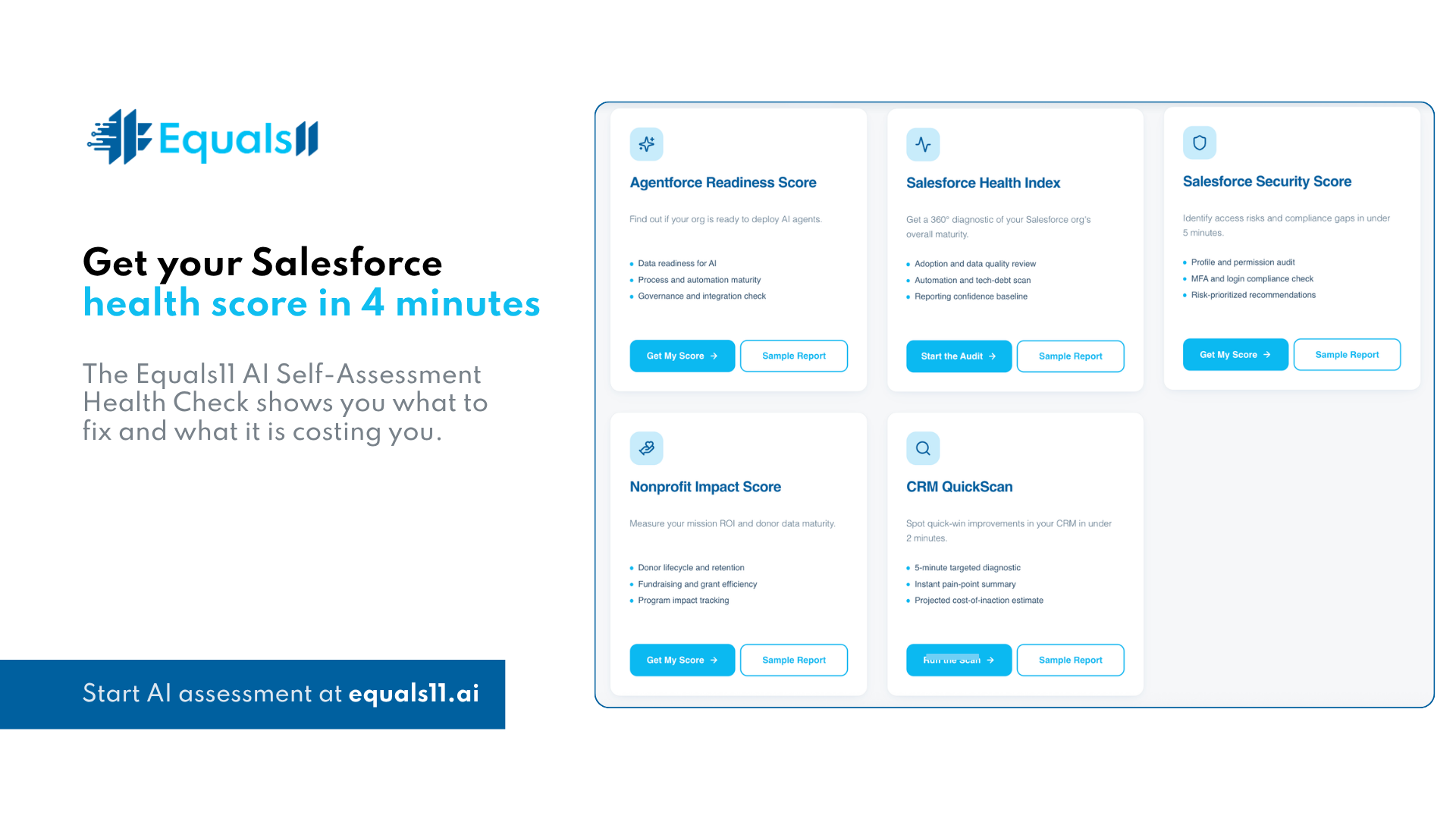
Equals11 helps mid-market and small enterprise companies optimize the Salesforce environments they already own. Two ways to start.
If your renewal conversation is coming up and the ROI question is on the table, the Free Health Check at equals11.com/healthcheck is the fastest way to find the leaks before the CFO does.
If the renewal conversation has already pivoted to AI readiness, run the AI Self-Assessment at equals11.ai. It tells you whether your org is structurally ready for Agentforce and Einstein, or whether you would be paying for capabilities your data model cannot support yet. Both answers matter at renewal time.
